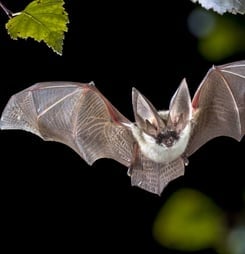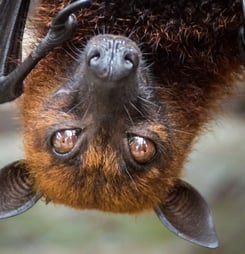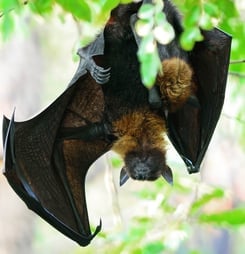
Bats have a terrible reputation among people because they’re seen as scary bloodsuckers that will spread diseases. However, according to scientists, very rarely do they spread diseases and few species drink blood, but rather eat fruit.
The population of bats has been depleting, and that is a problem because they contribute to the ecosystem more so than people think.
International Bat Appreciation Day aims to show love for these flying mammals and teach people the importance of bats in today’s world.
International Bat Appreciation Day Timeline
Spallanzani Shows Bats Navigate Without Sight
Italian biologist Lazzaro Spallanzani blinds and then deafens bats, demonstrating that hearing, not vision, is essential for their night navigation and anticipating the concept of echolocation.
Bats Placed in the Order Chiroptera
French zoologist Étienne Geoffroy Saint-Hilaire formally classifies bats in the order Chiroptera, recognizing them as mammals whose forelimbs are uniquely adapted as true wings.
Griffin Coins the Term “Echolocation” in Bats
American zoologist Donald R. Griffin publishes experiments proving that bats orient by emitting high-frequency sounds and listening to returning echoes, introducing the term “echolocation.”
Wildlife and Countryside Act Protects Bats in Britain
The United Kingdom’s Wildlife and Countryside Act comes into force, giving all native bat species and their roosts full legal protection and becoming a model for later bat-conservation laws.
Study Quantifies Bats’ Agricultural Value in the U.S.
Researchers writing in Science estimate that bats provide at least $3.7 billion per year in pest-control services to United States agriculture, underscoring their vital ecological and economic roles.
Learn About International Bat Appreciation Day
On International Bat Appreciation Day, we are reminded of the important role that bats play in our day-to-day lives.
You may not think that bats have any impact on your life at all! In fact, you may not really give much thought to this animal.
However, did you know that bats can eat as many as 1,000 mosquitoes in an hour? That’s 1,000 fewer mosquitoes that could possibly bite you! As bats are insectivorous, they actually get rid of a lot of annoying insects, and so we have a lot to thank them for. They role in the circle of life definitely benefits us.
International Bat Appreciation Day encourages us to learn more about these species and the role they play in nature. It is a good opportunity for you to learn more about bats, and you will find plenty of information online and in animal textbooks as well. After all, there are some very interesting facts about this species.
You probably know that bats are able to see in the dark and that they use their extreme sense of hearing. But, did you know that they are the only type of mammal that is able to fly in a true and sustained way?
Did you also know that bats are pollinators? This means that, along with the likes of butterflies and bees, they provide a critical link in our supply of food.
There are lots of other interesting facts that you can learn about bats on International Bat Appreciation Day. This includes the fact that there are more than 1,200 known species of bat. Around 70 percent of these bats are insectivores.
Bats also grow in a number of different sizes. The Giant Golden-Crowned Flying Fox Bat is one of the biggest bats.
It has a wingspan as big as five-feet, seven-inches, weighing up to four lbs. Bats also groom themselves constantly, making them very clean animals, which is something a lot of people do not realize.
In the United States, there are roughly 48 species of bats that call this their home. Three states in the U.S. also have an official state bat.
The Virginia Big-Eared Bat is the state bat in Virginia. The Mexican Free-Tailed Bat is the state bat of Oklahoma. Finally, this bat – the Mexican Free-Tailed Bat – is also the state bat of Texas.
History of International Bat Appreciation Day
Bat Conservation International started International Bat Appreciation Day to focus on protecting all the different species of bats. Bats protect ecosystems and help make sure our planet has a healthier future.
Bat Conservation International was founded in 1982 by a group of scientists concerned about our planet’s bats. After lots of research, they discovered that bats are important to help keep nature in balance, and are important to a lot of industries.
Scientists such as Dr. Merlin Tuttle, a recognized authority on bats, formed the organization. He made important progress by teaching more sustainable uses of natural resources that benefit both bats and people.
Bats play a significant role in the ecosystem of the world. There are over 1,300 species of bats in the world. Bats helps control agricultural pests, pollinate flowers and fruit, and create rich fertilizer for landowners, farmers, and local communities.
Without these bats, plants would fail at providing food for other wildlife species and surrounding ecosystems. Bats are one of the most under-studied animals, even though many of those bats are considered critically endangered, threatened, or vulnerable.
Forest depleting, inappropriate guano mining and thoughtless tourism have caused a substantial decrease in the populations of bats everywhere.
International Bat Appreciation Day aims to change the perspective on these misunderstood creatures and encourage people to help protect bats everywhere.
How to Celebrate International Bat Appreciation Day
Want to celebrate these furry, flying creatures of the night? Help support your local bat conservation organization by donating or volunteering to protect these adorable creatures. Share your love of bats with your friends and family by sharing facts about the different kinds of bats out there in the wild.
Take the time to educate people about the importance of bats in the world’s ecosystem. If you’re looking into becoming a biologist to study bats, then organizations such as the Bat Conservation International for career opportunities to help protect the world’s bats from extinction.
You can also expand your knowledge by taking a look online and reading up more about the species. There are also some good bat documentaries, which you can watch online or on television.
Another fun way to celebrate International Bat Appreciation Day is to watch some of the Batman movies! This fictional superhero first appeared in 1939 in Detective Comics #27. There have been a lot of different Batman films over the years.
This includes the 1989 Batman, Batman v Superman: Dawn of Justice from 2016, the 2006 The Dark Knight, Dark Knight Rises from 2012, and a number of others! So, get the popcorn in and celebrate this famous bat superhero!
Facts About International Bat Appreciation Day
Bat Pest Control Saves Billions in Agriculture
Insect‑eating bats provide enormous economic benefits by consuming crop pests at night.
A widely cited analysis in Science estimated that bats save U.S. farmers between $3.7 billion and $53 billion per year in avoided crop damage and reduced need for pesticides, largely by preying on moths, beetles, and other agricultural pests.
Similar studies in cotton fields have shown bats cutting pest numbers enough to reduce insecticide applications, which helps both farm profits and environmental health.
Bats Are the Second‑Largest Order of Mammals
Bats belong to the order Chiroptera and represent about 20 percent of all known mammal species, making them the second‑largest mammalian order after rodents.
More than 1,400 bat species have been described worldwide, occurring on every continent except Antarctica and occupying habitats from tropical rainforests to deserts and cities.
This diversity includes insect‑eaters, fruit‑eaters, nectar‑feeders, and even fish‑eating specialists, illustrating how evolution has pushed the bat body plan into an unusually wide range of ecological roles.
Bat Pollinators Sustain Iconic and Economically Important Plants
Nectar‑feeding bats are critical pollinators for hundreds of plant species, including culturally and economically important ones.
In Mexico, long‑nosed bats pollinate agave plants used to produce tequila and mezcal, while in Africa and Asia, fruit bats help pollinate baobab and durian trees.
Studies using genetic markers and pollen analysis have shown that bat‑mediated pollination can boost fruit set and maintain genetic diversity in these plants, directly linking bat activity to local food systems and traditional livelihoods.
Bat Seed Dispersal Helps Regenerate Forests
Fruit‑eating bats are key agents of natural reforestation, especially in tropical regions. Because many species fly long distances each night and defecate seeds in open or degraded areas, they help pioneer forest recovery far from parent trees.
Research in Latin America and Southeast Asia has documented bats dispersing seeds of early‑successional trees over kilometers, accelerating the regrowth of logged or burned forests and supporting biodiversity by creating habitat for other wildlife.
White‑Nose Syndrome Has Killed Millions of North American Bats
Since it was first identified in New York in 2006, white‑nose syndrome, a fungal disease caused by Pseudogymnoascus destructans, has devastated several cave‑hibernating bat species in North America.
The fungus disrupts hibernation, causing bats to burn through fat reserves and die before spring.
The U.S. Fish and Wildlife Service estimates that the disease has killed millions of bats across dozens of states and Canadian provinces, and has pushed some species, such as the northern long‑eared bat, to be listed as endangered because of rapid population declines.
Bats Show Unusual Longevity for Their Size
Many bat species live far longer than expected for small mammals, with some individuals documented at more than 30 years old in the wild.
Comparative studies have found that bats generally live three to ten times longer than other mammals of similar body size, a pattern linked to their low reproduction rate, efficient metabolism in flight, and robust DNA repair and immune systems.
This exceptional longevity has made bats a focus of aging research, as scientists investigate how they avoid many age‑related diseases common in other mammals.
Bat Echolocation Is Among Nature’s Most Sophisticated Sonar Systems
Most, though not all, bats navigate and hunt using echolocation, emitting high‑frequency calls and interpreting the returning echoes to build a detailed acoustic map of their surroundings.
Experiments have shown that some species can detect objects as thin as a human hair and distinguish between different types of prey based on the echoes they produce.
Advanced bioacoustic research has revealed that bats can adjust call frequency, intensity, and timing on the fly, effectively “zooming in” on targets in cluttered environments in ways that have inspired improvements in human sonar and radar technologies.