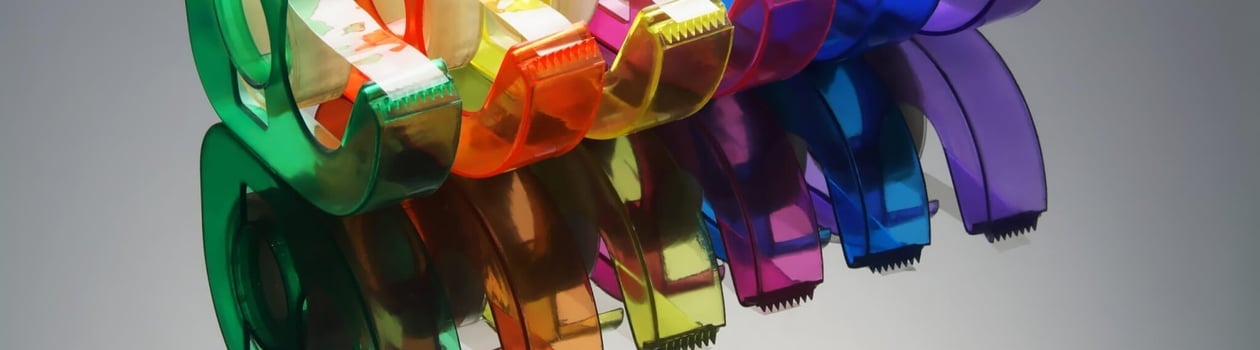
It’s clear, glossy, and oddly satisfying to unspool. It seals gift wrap, mends torn paper, labels lunch containers, and rescues countless little mishaps that do not deserve a full toolbox response.
Cellophane tape also has a knack for showing up at the exact moment someone says, “Hold on, I can fix that.” It shares desk space with pens and paper clips, teams up with staplers and scissors, and somehow manages to feel both totally ordinary and quietly miraculous.
National Cellophane Tape Day celebrates this humble strip of transparent problem-solving. It is a chance to appreciate the small engineering triumph behind a roll that can mend, organize, protect, and create, all with a quick press of the fingers.
How to Celebrate National Cellophane Tape Day
Use Some Cellophane Tape
Cellophane tape sparks creativity because it sits right between “sticky” and “almost invisible.” That mix makes it perfect for quick fixes, neat organization, and even simple art where glue might feel messy or slow.
Try a few classic “tape saves the day” moments, but do them on purpose.
- Patch a torn page or map: For paper that still needs to fold or flip, transparent tape is gentler than thick packaging tape. If the tear is uneven, align the edges first, then apply tape from the center outward to avoid wrinkles and bubbles.
- Reinforce a label: A strip of tape over a handwritten label protects it from smudges and splashes. Great for jars, storage bins, or travel bottles.
- Tame a fraying cord or ribbon: Wrap tape around the end to stop it from unraveling when threading it through a tag or handle.
- Make an instant lint lifter: Wrap tape around your hand, sticky side out, and pick up lint, hair, or dust easily. A small loop works for quick clothing fixes.
- Hold pieces in place during a craft: Tape can act like a temporary “third hand” while glue dries or while you draw guide lines.
Use tape for clean, no-commitment organization.
Cellophane tape is ideal when you need flexibility. It can stick a note to a monitor without leaving heavy residue or hold a small reminder card on a folder. It can also create simple “hinges” in paper projects like flashcards or foldable study tools.
Get playful with optical tricks and simple experiments.
Because it is clear, tape blends in, which makes it fun to use. It can create “invisible” repairs on wrapping paper, make cutouts look like they float, or help build quick photo props. It also works for easy experiments:
- Make a tape collage: Place strips on paper in patterns, add chalk dust or pigment, then peel to reveal clean designs.
- Build a quick “tape pull” art effect: Layer tape onto a painted surface and peel it off to create textured lines. It is simple and a bit unpredictable.
Do it safely and smartly.
Cellophane tape is easy to use, but still needs care.
- Keep it away from very young children who might wrap it too tightly around fingers.
- Avoid using it on delicate finishes or antique paper where adhesive can cause damage.
- For electrical fixes, always use proper electrical tape, not transparent tape.
The goal is not to finish the whole roll in one day, even if it feels tempting. The idea is to notice how often this small tool makes things easier, cleaner, and more secure.
Learn About Cellophane Tape
Cellophane tape looks simple: a clear strip with adhesive on one side. But behind it is careful material design that makes it work so smoothly.
What people usually mean by “cellophane tape.”
In everyday use, “cellophane tape” often means transparent pressure-sensitive tape, the kind found in a desk dispenser. It is easy to tear, sticks with light pressure, and unrolls smoothly. It is often linked to a well-known brand, but the idea goes beyond any one company.
It is not just the adhesive.
Good tape works because the backing and adhesive are balanced. If the backing is too stiff, it lifts. If it is too stretchy, it wrinkles. If the adhesive is too strong, it damages paper. Too weak, and it will not hold.
That balance explains why some tapes are perfect for gift wrapping and paper, while others suit heavier jobs like sealing boxes. Cellophane tape fits the “light-duty, clean finish” category where appearance matters.
The surprisingly “magical” x-ray phenomenon.
Cellophane tape is known for a curious scientific effect: under certain conditions, peeling it can produce x-rays. This connects to phenomena like triboluminescence, where materials create energy when pulled apart or rubbed. In everyday life, this may show up as small crackles or sparks, especially in dry air.
In controlled environments, the effect becomes stronger. Peeling tape can build electrical charge, and when that charge releases, it can produce x-rays. It sounds surprising for such a simple object, which is part of what makes it fascinating.
It is important to remember: this is not something to try at home. X-rays are not safe without proper equipment. The takeaway is simply that everyday materials can behave in unexpected ways.
Why tape gets cloudy or yellow over time.
Old tape often turns yellow, dries out, or loses stickiness. This happens because of light, heat, air, and moisture affecting the adhesive. Tape made for archiving lasts longer, while regular tape is meant for short-term use.
The brand name that became a generic term.
Many people call all transparent tape by a well-known brand name. This happens when a product becomes so popular that its name represents the entire category. It shows how essential it has become in daily life.
National Cellophane Tape Day Timeline
Brandenberger invents cellophane
Swiss chemist Jacques E. Brandenberger creates a thin, transparent, regenerated cellulose film he calls “cellophane,” originally to make spill‑proof tablecloths but soon used for food wrapping.
3M begins work on transparent adhesive tapes
Richard Gurley Drew at Minnesota Mining and Manufacturing Company (3M) starts developing pressure‑sensitive transparent tapes, first for auto painters, laying the groundwork for later cellulose-based office tapes.
Invention of transparent cellophane adhesive tape
Richard Gurley Drew invented the first practical transparent cellophane adhesive tape, combining a clear cellulose film with a pressure‑sensitive adhesive, making a nearly invisible mending and sealing tape.
Refinement and popularization of the household tape
Throughout the 1930s, transparent cellophane tape was adapted from industrial use to household and office tasks, with 3M marketing it for mending, sealing, and gift wrapping and introducing improved dispensers by the end of the decade.
Wartime applications expand tape technology
During World War II, transparent and other pressure‑sensitive tapes were widely used for sealing aircraft windows, insulating equipment, and protecting parts, driving innovations in adhesive formulations and backing materials.
Discovery of X‑ray emission from peeling tape
Researchers first reported that peeling adhesive tape, including cellophane tape, in a vacuum can emit X‑rays, an early observation of intense triboluminescence and a surprising physical property of common pressure‑sensitive tapes.
Detailed study of X‑rays from Scotch tape
Physicists at UCLA show that peeling ordinary Scotch tape in a vacuum produces bursts of X‑rays strong enough to create images of human bones, bringing renewed scientific attention to the physics of adhesive tape.
History of National Cellophane Tape Day
Cellophane tape appeared in the early 20th century, during a time of rapid growth in manufacturing and packaging. As transparent wrapping materials became popular, people needed a neat way to seal them without ruining the look. That need led to clear adhesive tape.
The relationship between cellophane and “cellophane tape.”
Cellophane is a thin, transparent film made from plant-based cellulose. It is different from most plastics, even though it looks similar. It became popular for packaging because it protected products while keeping them visible.
Once transparent films were used widely, a matching transparent tape made perfect sense. It allowed sealing without covering labels or affecting appearance. That invisible support role still defines how it is used today.
Richard Gurley Drew and the rise of transparent tape.
A key figure in the development of transparent tape was Richard Gurley Drew. He worked on early pressure-sensitive tapes designed for real-world use.
One well-known story tells of a painter who tested tape and complained about weak adhesive, using the word “Scotch” to describe it. The name stayed and later became one of the most recognizable tape brands.
The real lesson from this story is simple: tape had to be reliable. If it failed, it created more problems than it solved. Early development focused on improving adhesive quality, backing materials, and consistency.
From specialized solution to everyday essential.
Transparent tape started as a useful tool but quickly became a daily essential. It solved small problems easily, without drying time or extra tools. It worked well for wrapping, fixing paper, and quick repairs.
As offices and schools grew, tape became even more important. Teachers, retailers, and families all relied on it for everyday tasks.
Why it still matters, even with digital everything.
Even today, physical objects still need fixing. Labels peel, paper tears, and packages need sealing. Transparent tape remains useful because it works instantly and requires no special skill.
A day devoted to the little roll that could.
National Cellophane Tape Day celebrates small inventions that make life easier. It highlights how simple improvements—better adhesive, smoother use, cleaner results—can have a lasting impact. Transparent tape may seem small, but its story shows how even the simplest tools can matter.
Surprising Facts About Cellophane Tape You Probably Didn’t Know
Cellophane tape may seem like a simple everyday item, but behind that clear strip lies a story of innovation, science, and unexpected discoveries.
From transforming major companies to producing X-rays under extreme conditions, these facts reveal just how fascinating this small tool really is.
Cellulose Tape Helped Transform 3M From Sandpaper Maker to Innovation Giant
When Richard Gurley Drew developed transparent cellulose tape in the early 1930s, 3M was still primarily a sandpaper company.
The runaway success of his pressure-sensitive tapes pushed 3M to diversify into adhesives and office products, setting a pattern of research-driven innovation that turned the firm into a global technology company with thousands of products across healthcare, electronics, and consumer goods.
The First Transparent Tape Solved a Depression-Era Packaging Problem
Transparent cellophane tape was initially created to help grocers and bakers seal cellophane food wrappers neatly and cheaply, especially for items like bakery goods and produce.
During the Great Depression, the ability to repair torn packaging and everyday household items with this clear tape made it especially valuable, since people were trying to stretch the life of everything they owned.
Peeling Tape in a Vacuum Can Emit Enough X‑Rays to Image a Finger Bone
Physicists have shown that peeling ordinary adhesive tape in a vacuum can generate bursts of X‑rays through a phenomenon known as triboluminescence, in which mechanical energy is converted into light or higher‑energy photons.
In controlled experiments, the X‑ray flashes from peeling tape were intense and brief enough to produce an X‑ray image of a human finger, although the effect is not significant at normal atmospheric pressure.
Cellophane Tape Uses a “Tacky but Not Runny” Solid Adhesive
The sticky part of typical cellophane tape is a pressure‑sensitive adhesive that behaves like a cross between a liquid and a solid.
Made from polymers and tackifying resins, it softens just enough under light pressure to flow into tiny surface irregularities, then holds fast without needing heat or solvent.
This balance of viscoelasticity makes the tape removable by peeling yet strong enough to resist shear forces in everyday use.
Early Transparent Tapes Were Based on Regenerated Cellulose, Not Plastic Film
The original “cellophane” backing on transparent tape was made from regenerated cellulose derived from wood pulp or cotton linters, similar to rayon and other early semi‑synthetic materials.
This cellulose film was clear, glossy, and could be moisture‑resistant when coated, which made it ideal for packaging. Over time, many consumer tapes shifted to plastic films like polypropylene for lower cost and greater durability, even though the “cellophane” name stuck.
Transparent Tape Became a Wartime Utility Material During World War II
During World War II, transparent pressure‑sensitive tapes were used well beyond office desks.
They helped seal and repair ammunition boxes, protect equipment from moisture, and bundle components in factories, at a time when metal fasteners and other materials were tightly rationed.
These industrial and military uses accelerated improvements in adhesive formulations and backing strength that later benefited everyday office and household tapes.
Early Masking Tape Invention Led Directly to Transparent Cellulose Tape
Before inventing transparent cellulose tape, Richard Drew had created one of the first successful masking tapes in the 1920s to help auto body shops paint clean two‑tone lines on cars.
The experience of engineering a removable, pressure‑sensitive adhesive that would not damage fresh paint gave him crucial knowledge in adhesive chemistry and backing materials, which he later applied to the clear, more delicate cellophane tape used on packaging and paper.