
If there’s a sexier sound on this planet than the person you’re in love with cooing over the crepes you made for him, I don’t know what it is.
Julie Powell
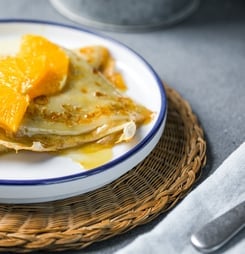
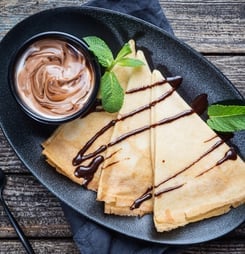
Forget the pancakes! They have no subtlety, they’re just big bready flops of dough on the pan, and crepe that needs to go on a diet. National Crepe Day encourages people to turn their fat pancakes into a thinner, better version and enjoy the absolutely delicious bit of airy breakfast, lunch, or dinner that is the crepe.
There are so many ways to prepare these delicious treats, and National Crepe Day is the best possible excuse!
How to Celebrate National Crepe Day
Because of its delicious versatility, National Crepe Day can be celebrated in all sorts of ways! Try out these ideas or come up with some new and unique ones:
Eat Crepes for a Meal
Have a hankering for a fruity breakfast? Put some peaches on those crepes, then add a bit of cream, roll them up and, voila, it’s delicious! What’s that? Someone else wants a savory dinner? No problem. There’s nothing like a rich beef and mushroom-filled crepe that is drizzled with gravy to round out the day.
In fact, from the French perspective, where this dish originated, crepes are not actually a breakfast food and are supposed to be eaten for dinner anyway!
Celebrate with French Traditions
On National Crepe Day, a variety of interesting traditions are celebrated–some of which are related to crepes and some are not. Observers of this day seem to have many different sayings that go along with this day, including:
- On Candlemas, the winter either ends or gets worse.
- Candlemas covered in snow means 40 days of weather lost.
- On Candlemas, the day grows by two hours.
- Dew on Candlemas means winter at its final hour.
Eat Crepes for a Snack or Dessert
Is it snack time? Peanut butter and jelly on the cold leftover crepes from this morning make a perfectly quick and tasty treat. That’s right, crepes can be anything–just about anything at all! Looking for another favorite idea? Fresh chocolate chip crepes filled with frozen vanilla yogurt and drizzled with caramel sauce are absolutely divine.
Some people might ask, “What about cake?” Well, that’s not difficult at all. Take a rich vanilla filling and then lay down a crepe. Paint it with the filling, put on another crepe, another layer of filling, and just keep going until it is the equivalent of a Dagwood sandwich, packed with goodness and towering to the sky!
Get Creative with Crepe Flavors
Celebrating crepe day is as simple as eating a delicious crepe! What other encouragement is needed?
Pumpkin spice crepe. Sure! Apple cinnamon crepes filled with sliced apples in a cinnamon sauce and drizzled with caramel. Who wouldn’t love that? How about filling them with crème and then topping them with cherry pie filling? Get in that kitchen and let that imagination run wild.
National Crepe Day FAQs
History of National Crepe Day
Crepes are a form of pancake, so perhaps it might be a little less than fair in slamming on them in the introduction. But, also, most people will admit that crepes are everything a pancake wants to be and isn’t!
But while pancakes often leave the eater with a heavy full feeling that can turn into weariness, the crepe is completely different! A crepe is a light bit of flavor wrapped around an amazing filling. And what goes in them? Well, that’s the magic of crepes, because they can be just about anything!
National Crepe Day, or La Chandeleur, is a celebration that originated in France and is observed by those in the Catholic church. Some believe the celebration was started by Pope Gelasio I in 472 AD.
Landing exactly 40 days after the celebration of Christmas, it also serendipitously falls on the midway point of winter, making the day a combination of both. The day is also called Candlemas, which seems to be related to the candles that are lit during the religious services.
One historical tradition began when the popes would give out food to the poor people each year on this day, encouraging the idea of sharing. Now it seems to be a day that is enjoyed by inviting friends and family over to eat crepes and celebrate.
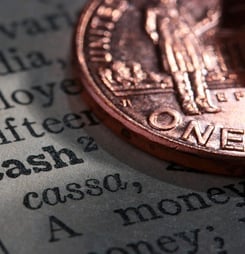
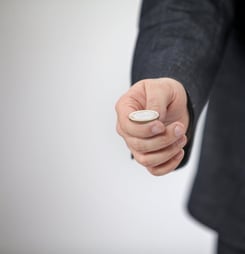
For many, this day comes with all sorts of superstitions and omens. For instance, the round shape of the crepe represents the circle of life and the sun for a sign of hope. Some people might cook their crepes with a coin on top during the process of cooking, for good luck. Others think that it’s good luck to flip the crepe with the left hand while holding a coin in the right–without dropping it on the floor!
Some people even save the first crepe from the batch and place it in the top drawer of a wardrobe to ensure luck and prosperity for the year that is to come. One other tradition that goes along with crepes on this day is enjoying hard cider but, instead of drinking it out of a glass, they would drink it out of a round bowl.
In a similar vein to Groundhog Day, National Crepe Day seems to have implications for the future of the weather. It is believed that if it rains on La Chandeleur, then forty more days of rain showers will be expected.
National Crepe Day is filled with all sorts of fun traditions and rituals for those who are superstitious–and for those who just love to eat crepes!
National Crepe Day Timeline
Crepe Day originates
Called Le Jour des Crêpes in French, this day is believed to have started when French Catholic pilgrims visiting Rome for Candlemas are given something akin to a crepe. As Candlemas takes place on February 2, their origins may be linked.
Buckwheat is introduced to Brittany
Buckwheat makes its way to Brittany, France around this time. While some crepes today are now made of wheat flour, the traditional version from this northwestern region of France is made of buckwheat flour.
Buckwheat crepes originate
The legend goes that in Brittany, France, a housewife who is making buckwheat porridge accidentally drips some onto a hot cooking stone. It seems edible so she tries it and it ultimately grows into a cultural phenomenon.
Gare Montparnasse train connects Brittany to Paris
When the train line connects Brittany, where crepes originate, to the capital city, people flock to Paris selling their exports from Brittany. Crepe shops and stands begin popping up all over Paris. Now almost every town in France has its own creperie–if not dozens or even hundreds of them!
White flour is used in crepes
As processes changed, white flour became more commonly used in the making of crepes, particularly the versions that are sweeter. Still today, however, a more traditional savory crepe will be made of buckwheat flour, also rendering it gluten free.