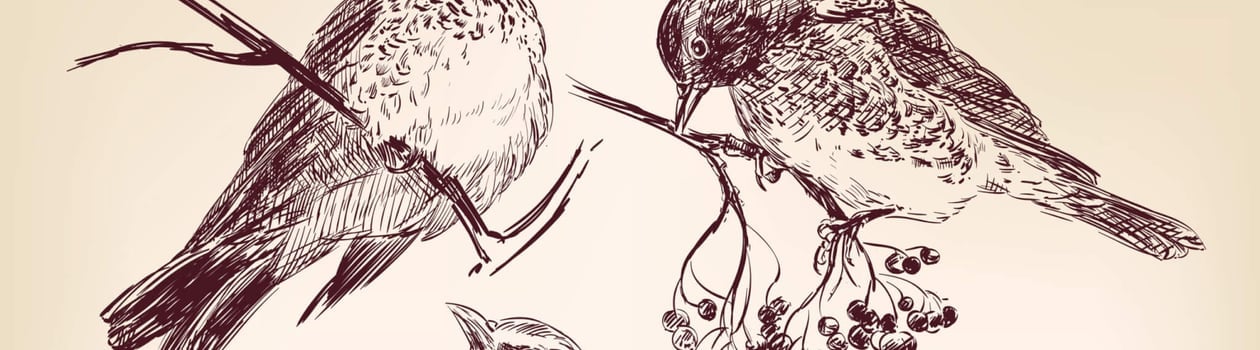
Grab a pencil, some paper, and a little bit of inspiration and get to drawing because this is the time to celebrate Draw a Picture of a Bird Day!
Draw a Picture of a Bird Day Timeline
Birds in Paleolithic Cave Art
Prehistoric artists depict birds alongside other animals on cave walls, showing that people have been sketching avian forms since the earliest known figurative art.
Frederick II’s “The Art of Falconry”
Holy Roman Emperor Frederick II commissions “De Arte Venandi cum Avibus,” one of the earliest systematic works to include careful observational descriptions and illustrations of birds.
Renaissance Naturalists Draw Birds from Life
Artists and naturalists such as Albrecht Dürer and Conrad Gessner produce detailed bird studies and woodcuts, helping to shift bird images from symbolic motifs to realistic, scientific observation.
Catesby Publishes “The Natural History of Carolina”
Mark Catesby issues his illustrated volumes on the birds and other wildlife of North America, among the first large-scale color images of American birds published in Europe.
Audubon’s “The Birds of America”
John James Audubon publishes his monumental series of life‑sized bird plates, blending art and science and setting a new standard for bird drawing and identification.
John Gould’s Lavish Bird Monographs
English ornithologist John Gould oversees richly colored lithographic plates of hummingbirds, toucans, and other groups, popularizing bird illustration for both scientists and the public.
From Field Guides to Modern Bird Sketching
With the rise of portable field guides and later teachers like John Busby and John Muir Laws, drawing birds becomes a key tool for birdwatchers and educators, encouraging anyone to sketch from observation.
How to Celebrate Draw a Picture of a Bird Day
Pencil, pen, felt tip or chalk, Draw a Picture of a Bird Day is great fun for everyone.
It’s very straightforward: simply draw a picture of a bird in tribute to our feathered friends, but if you fancy some diversity there’s actually a wide range of options. Try some of these ideas for celebrating the day:
Draw a Picture of a Bird
Will you draw a chicken or a chaffinch? Perhaps a peacock, penguin or puffin? For those who would prefer to draw a goose, will it be of the Canadian, Red-breasted, Woods-walking or Spur-winged variety? And you’d be amazed by how many types of hawk there are prowling the skies!
Anyone looking for reference images of birds can find a pretty extensive list of birds by common name on Wikipedia.
Share the Day with Friends and Family
For those who would rather just have a bit of fun and get arty, why not share this occasion of Draw a Picture of a Bird Day with friends, family and coworkers?
Perhaps it would be fun to have a competition to see who can draw the best or funniest bird. Make a point to cover the fridge in sketches.
Find a chalkboard and create a beautiful aerial scene of spiraling swifts and swallows. Or simply pop a little cartoon birdy on your hand and introduce it to strangers on the bus.
Try Using Some Bird Drawing Books
Folks who are interested in learning more about how to draw birds in honor of Draw a Picture of a Bird Day might want to check out some books from the local bookstore or library.
Of course, YouTube tutorials are also a nice option for step by step video instructions.
For books, try some titles such as these:
- Drawing Birds by John Busby (2004)
- Drawing Birds with Colored Pencils by Kaaren Poole (2008)
- The Laws Guide to Drawing Birds by John Muir Laws (2012)
- Drawing Cute Birds in Colored Pencil by Ai Akikusa (2016)
History of Draw A Picture of a Bird Day
Draw a Picture of a Bird Day actually has a history that dates back more than seven decades and the day has a beautiful origin story. In 1943, during World War II, a seven-year-old girl named Dorie Cooper visited her uncle, who was a wounded soldier in a hospital in England.
While she was there, she asked him to draw a bird as she thought it might help to cheer him up and lighten his mood.
Although Dorie laughed at the picture of the bird her uncle had drawn and declared him not such a great artist, it did accomplish the task of cheering him up.
And because he shared the story with his fellow wounded soldiers, many of them also began holding contests for drawing pictures of birds. They would have them hung about the hospital ward so that all the walls were covered within a few months. It not only cheered up Dorie’s uncle, but many other soldiers as well!
Tragically, Dorie was killed in an automobile accident just three years later. And because the story of Dorie’s inspiration had been told, there were many drawings and pictures of birds at her funeral, brought by soldiers, nurses, doctors and others.
Draw a Picture of a Bird Day was first celebrated on Dorie’s birthday, April 8th, in 1947, the year following her death.
Since then, the day has been celebrated each year to not only commemorate the impact that Dorie made on the lives of wounded soldiers, but also to encourage others to live out her example of encouragement to those around her.
By 2011, the annual celebration of Draw a Picture of a Bird Day had made its way to social media and had even gained its own website and hashtag.
Facts About Draw a Picture of a Bird Day
Invisible Colors in Bird Plumage
Many birds are covered in colors humans cannot see, because their feathers reflect ultraviolet light that falls outside the human visual spectrum.
Studies using special cameras and models of avian vision suggest that up to 90 percent of songbird species that appear similar or even identical to us actually show clear color differences in UV to other birds, especially between males and females.
How Birds See More Colors Than Humans
Humans typically have three kinds of color-sensitive cones in their eyes, but most birds have four, including one tuned to ultraviolet wavelengths.
Experiments with wild broad-tailed hummingbirds show they can distinguish “nonspectral” colors, such as ultraviolet mixed with green or red, that people cannot even imagine, expanding their perceived color palette far beyond ours.
Oil Droplets That Sharpen Avian Vision
Bird retinas contain tiny carotenoid-rich oil droplets inside their cone cells that act like built-in color filters.
These droplets fine-tune the light that reaches each cone, improving contrast and making it easier for birds to discriminate subtle differences in plumage colors and patterns, which can be crucial for recognizing mates or rivals.
From Audubon to Field Marks: The Evolution of Bird Art
Early ornithological art focused on dramatic, life-sized portraits of individual specimens, exemplified by John James Audubon’s 19th-century “Birds of America.”
In the 20th century, artists such as Roger Tory Peterson revolutionized bird illustration by simplifying poses and adding arrows to highlight key “field marks,” turning paintings into practical identification tools rather than pure works of art.
The “Typical Bird” That Does Not Exist
Modern field guide illustrators rarely paint a single real bird; instead they blend features from many individuals to create an idealized “average” bird for each species.
Educator and illustrator John Muir Laws notes that this composite approach, along with standardized lighting and simplified shadows, makes it easier for birdwatchers to match what they see in the field to the image on the page.
Drawing as a Powerful Memory Tool
Laboratory studies comparing note-taking methods have found that drawing information leads to better recall than writing or simply viewing pictures.
Because sketching requires integrating motor actions, visual analysis, and conceptual thinking, people later remember drawn experiences with more detail and accuracy than similar information recorded only in words.
Bird’s Nest Drawings in Art Therapy
In art therapy, the “Bird’s Nest Drawing” task asks people to draw a nest and often reveals how secure or vulnerable they feel.
Research using this technique has found that images of sturdy, well-contained nests with birds present tend to correlate with more secure attachment patterns, while empty or precarious nests often appear in drawings by individuals with histories of insecurity or trauma.