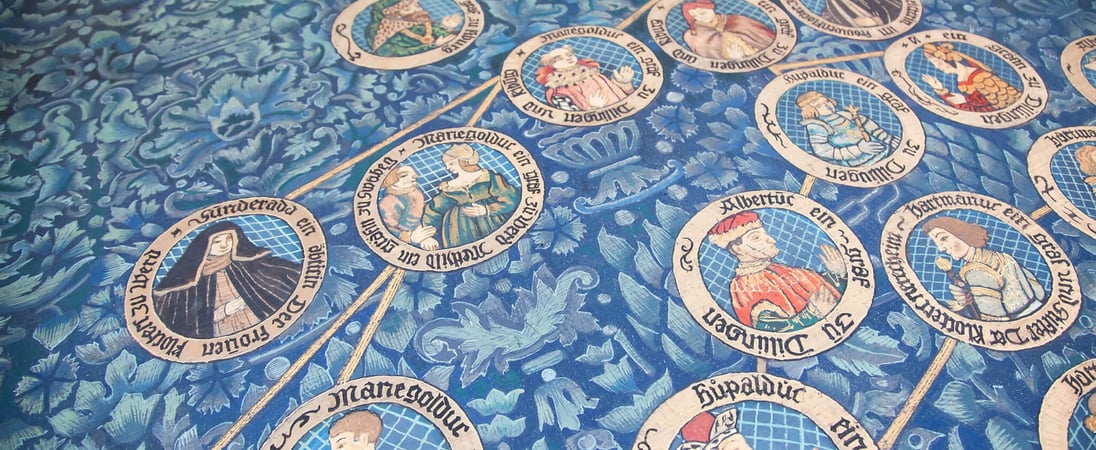
National Genealogy Day
Digging into family trees unveils a captivating journey through generations, offering insights into heritage and the lives of ancestors.
Many of us are too preoccupied with our lives to think too much about the past, especially ancestors of ours who lived and died perhaps hundreds of years ago.
Every now and then, however, people who happen to have a bit more time start digging around and sometimes find out the most fascinating facts about where their forefathers came from and what kind of people they were.
Think about it: aren’t you just a little bit curious? If so, National Genealogy Day
National Genealogy Day Timeline
c. 551–479 BCE
Genealogical Records of Confucius Begin
Descendants of the Chinese philosopher Confucius start maintaining a family lineage that will be updated for more than 2,000 years, creating one of the world’s longest continuous documented family trees.
c. 1086
Domesday Book and Medieval Lineage in England
William the Conqueror orders the Domesday Book, a vast survey that records landholders and their heirs, reflecting how genealogy underpins feudal rights, inheritance, and social status in medieval England.
1538
Parish Registers Ordered in England
King Henry VIII’s government instructs every parish in England and Wales to keep registers of baptisms, marriages, and burials, creating a continuous record that later becomes a core source for genealogical research.
1837
Civil Registration Introduced in England and Wales
The British government begins compulsory civil registration of births, marriages, and deaths, providing standardized certificates that transform family history from scattered church notes into formal legal records.
1894
Founding of the National Genealogical Society in the United States
Researchers establish the National Genealogical Society in Washington, D.C., one of the first national organizations devoted to improving genealogical methods, publishing research, and preserving family history records.
2006
Commercial DNA Testing for Genealogy Takes Off
Companies such as 23andMe and others begin offering direct‑to‑consumer DNA testing, making genetic genealogy widely accessible and giving family historians a new tool to confirm lineages and discover unknown relatives.
History of National Genealogy Day
The idea of keeping track of one’s family tree is not a new one. The family tree of Confucius, for example, has been maintained for over 2,500 years, a Guinness World Record.
In Western societies, genealogy was especially important to royalty, who used it to decide who was of noble descent and who was not, as well as who had the right to rule which geographical area.
Much like the ancient Egyptians’ assertions that their pharaohs were part god and part man, the medieval Anglo-Saxon Chronicle claimed that the god Woden (perhaps better known as the Norse god Odin) himself was a direct ancestor of several English kings.
National Genealogy Day was created in 2013, by Christ Church, United Presbyterian and Methodist in Limerick, Ireland to help celebrate the church’s 200th anniversary.
For this day, Christ Church brought together local family history records not only from its own combined churches but also from the area’s Church of Ireland parishes, including the Religious Society of Friends in Ireland (Quaker) and the Church of Latter-Day Saints (Mormon).
The people in attendance could then use the amassed marriage and baptism records dating back to the early 1800s, such as Limerick Methodist Registers and Limerick Presbyterian Registers, to find out about their great-great-grandparents.
The idea proved so popular that the day was repeated for the next two consecutive years and has inspired many people to take a look into their family tree to find out a bit more about where they come from.
How to Celebrate National Genealogy Day
There’s no doubt that the best way to celebrate this day is to look into your own roots. Of course, we cannot guarantee that all of your discoveries will be pleasant ones about heroes and royalty.
New York filmmaker Heather Quinlan, for example, found quite a few skeletons when digging around in her ancestors’ closet.
As it turned out, her grandmother’s great-grandfather had beaten a man to death with a chair in a drunken brawl.
Other members of her family also turned out to be colorful characters, to say the least, and many of them had engaged in a murderous feud in the 1830s.
One of Quinlan’s great-grandfathers managed to escape jail after having killed several people after the jailer forgot to lock the cells, leading Quinlan to quip: “It was like the Hatfields and McCoys meet Romeo and Juliet, with a touch of ‘Mayberry R.F.D.’ thrown in.”
Regardless of what you find, however, celebrating National Genealogy Day will surely prove an entertaining way to spend a few hours of your time. Who knows, maybe you will become so fascinated that genealogy will become a new hobby?
Facts About Genealogy Day
Confucius’s Family Tree Is One of the Longest Continuous Genealogies in the World
The descendants of the Chinese philosopher Confucius have maintained written genealogical records for more than 2,500 years, documenting over 80 generations and reportedly including millions of living descendants in the most recent published editions.
Medieval European Genealogy Was a Tool of Political Power
In medieval Europe, royal and noble families used carefully crafted genealogies to legitimize claims to thrones, land, and titles, sometimes fabricating or stretching lineages to connect themselves to heroic figures, biblical characters, or ancient Roman nobles.
The Mormon Church Built One of the World’s Largest Genealogical Archives
The Church of Jesus Christ of Latter-day Saints has collected billions of historical records worldwide since the late 19th century, storing microfilmed and digital copies of civil, church, and census records in its Granite Mountain Records Vault near Salt Lake City and making many of them freely accessible online.
DNA Testing Sparked an Ancestry Boom in the 21st Century
Direct‑to‑consumer genetic testing exploded after 2012, with companies like AncestryDNA and 23andMe collectively processing tens of millions of tests; by 2019, estimates suggested more than 26 million people had added their DNA to commercial genealogy databases, dramatically expanding tools for family history research.
African American Genealogy Is Often Hindered by Slavery‑Era Records
For many African Americans, tracing ancestors beyond the 1870 U.S. census is difficult because enslaved people were usually listed as property rather than by name in earlier records, so researchers often rely on indirect sources like plantation documents, wills, and bills of sale to reconstruct family lines.
Iceland’s National Database Lets Citizens Check Kinship Before Dating
Iceland maintains a comprehensive national genealogy database known as Íslendingabók, which traces most of the population back centuries; a companion app has even been used informally by young people to check how closely related they are to a potential partner in such a small gene pool.
Surname Patterns Can Reveal Ancient Migrations and Social History
Studies of surnames in Europe and Asia show that family names often cluster in specific regions and can be traced back hundreds of years, allowing researchers to estimate historical population movements, endogamy, and even past social structures such as caste and clan systems.
National Genealogy Day FAQs
What are the main types of records genealogists rely on, and why do they matter?
Genealogists typically build family trees from a mix of vital records (birth, marriage, and death certificates), census and population registers, immigration and naturalization files, church parish registers, military records, land and probate documents, and local newspapers or obituaries.
Each record type contributes different pieces of evidence, such as names, approximate ages, relationships, occupations, and locations, which can be compared and cross-checked to reconstruct accurate family histories over time.
How is genealogy different in countries that rely on oral tradition instead of written records?
In communities that emphasize oral history, such as many Indigenous, African, and Pacific Island cultures, genealogical knowledge is often preserved through stories, songs, clan histories, and community elders rather than formal documents.
Researchers in these settings usually prioritize respectful interviews, community collaboration, and cross-checking multiple storytellers, sometimes later supplementing oral accounts with church, colonial, or civil records where they exist.
What is the relationship between genealogy and consumer DNA testing?
Documentary genealogy uses records to trace people through time, while consumer DNA testing analyzes segments of a person’s genome to estimate biological relationships and ancestral origins.
When used together, DNA results can confirm or challenge paper-based family trees, help identify unknown biological relatives, and suggest deeper geographic or ethnic roots, although DNA matches always require careful interpretation and documentary evidence to place people correctly in a family tree.
What are some common mistakes beginners make when building a family tree?
Beginners often copy unsourced online trees, assume people with the same name in a region are the same person, or accept family stories without verification.
They may also overlook spelling variations, rely on a single record as proof, or fail to record full source citations.
Professional genealogists recommend starting with oneself and working backward, using multiple independent records for each fact, and treating all family lore as clues that still need evidence.
Why can researching African American or other historically marginalized families be especially difficult?
For many African Americans and other marginalized groups, written records before the late 19th century may be sparse, fragmented, or created by enslavers or colonial authorities who did not record full names or family relationships.
Forced migration, enslavement, name changes, segregation, and discriminatory record-keeping practices mean researchers often have to rely on a combination of freedmen’s records, plantation documents, tax rolls, oral history, and DNA evidence to reconnect families that were deliberately separated.
How do privacy and ethics come into play in genealogy and genetic ancestry research?
Ethical genealogy requires respecting the privacy and preferences of living relatives, being cautious about sharing sensitive information, and understanding that DNA tests can reveal unexpected parentage, adoptions, or donor conception.
Experts advise obtaining consent before publishing details about living people, carefully reading DNA company terms of service, and considering the legal and emotional consequences of contacting or identifying relatives who may not want to be found.
Can genealogy research ever be considered “finished”?
Most professional genealogists view family history as an ongoing project rather than something that can be completely finished.
New record collections, digitization projects, and DNA matches appear over time, while improved methods or fresh evidence can overturn earlier conclusions.
As a result, serious researchers treat their trees as working hypotheses that are continually updated and corrected as better information becomes available.
Also on ...
View all holidays

National Pi Day
An exciting day for math enthusiasts, celebrate this famous number — it's the ratio of the circumference of a circle to its diameter — with infinite enthusiasm and endless fun!

International Day of Mathematics
Whether you're designing a skyscraper, or simply counting up your spare change, a strong foundation in mathematics is essential.
We think you may also like...
Namesake Day
Discovering connections through shared names, it's like stumbling upon unexpected bonds that create a sense of camaraderie and uniqueness.

National Father Daughter Take a Walk Day
Strolling hand in hand, they explore nature's wonders, sharing laughter and creating cherished memories under the open sky.