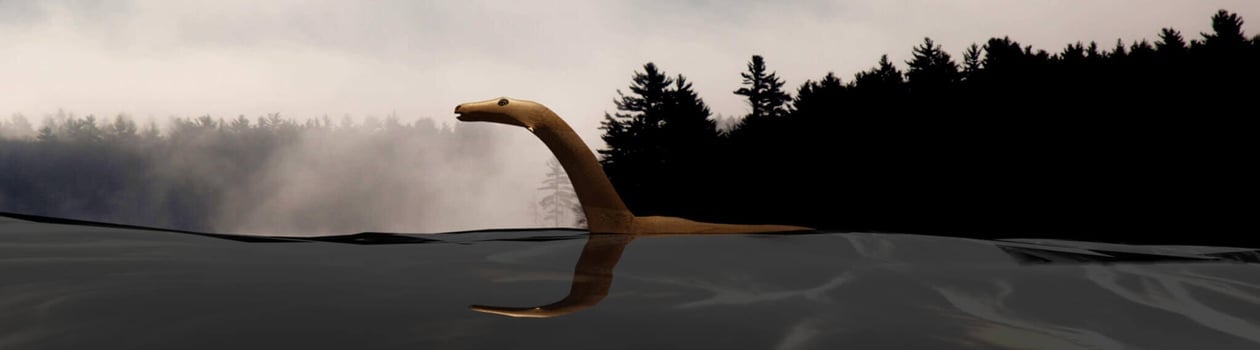
The modern legend of the Loch Ness monster, known by Scottish locals as “Nessie”, has been described as a shy, quiet creature who might have surprised or frightened folks but who has never harmed anyone. That gentler interpretation is part of the charm.
A mysterious animal that prefers privacy fits neatly into the atmosphere of a long, dark freshwater loch where mist, wind, and rippling water can play tricks on the eye. In many retellings, Nessie is less villain than local celebrity: elusive, camera-shy, and perfectly content to keep humans guessing.
Other tales, however, have placed Nessie as an enormous nuisance, “rolling and plunging” along the surface of the water in pursuit of swimmers. That version leans into classic monster-story excitement, where the lake itself becomes a stage for sudden drama.
A rise of water, a hump-like shape, a wake that seems to move against the wind, and suddenly the imagination supplies the rest. It is not hard to see why the story has survived for so long, because it is flexible enough to be spooky or sweet depending on the storyteller.
No matter what her personality or demeanor, this monster has earned a place in the hearts of people all over the world, so much so that she now has a day dedicated to her: International Loch Ness Monster Day!
It is a celebration of curiosity and folklore, of mysteries that refuse to be neatly solved, and of the delight people take in looking out over a stretch of water and wondering what might be swimming just below the surface.
How to Celebrate International Loch Ness Monster Day
Visit Inverness Loch Ness in Scotland
It seems the best way to celebrate International Loch Ness Monster Day might be to head over to Scotland and see these sightings firsthand. The scenery is beautiful, the people are friendly, and there is plenty to see and do, even if a monster sighting doesn’t make it to the agenda.
Loch Ness itself is a great co-star in the story. The water is famously dark, stained by peat from the surrounding landscape, and visibility can be limited even on bright days. That murkiness is one reason the legend feels so plausible to visitors: it creates a natural sense of “anything could be down there.”
The loch is also long and deep, with steep sides in many areas, which adds to the impression that it could hide something substantial. Even without Nessie, it is the kind of place that invites quiet observation, long walks, and a few dramatic photographs.
A Nessie-themed visit does not have to be an all-day stakeout with binoculars, though that can certainly be part of the fun. Many travelers make a point of stopping at viewpoints, strolling along shore paths, or joining a boat trip to experience the loch from the water.
Each angle offers a different kind of suspense. From shore, the mind tends to interpret patterns in waves and wakes. From a boat, the scale feels bigger, the water feels deeper, and the idea of an unseen presence becomes more vivid.
A practical approach makes the outing more enjoyable. Dressing for changeable weather, bringing a warm drink, and packing a pair of simple binoculars can turn a quick look into a comfortable, lingering experience.
For those who like a bit of structure, it can be fun to treat the day like a mini field expedition: pick a few observation spots, compare what the loch looks like at each, and keep notes on what conditions are like when the water seems most “mysterious” (wind, light, boat traffic, and cloud cover all shape the surface).
Even if the trip does not include a “sighting,” it still delivers the essential ingredient: atmosphere. International Loch Ness Monster Day is not only about proving anything. It is about stepping into a story that has been told and retold for generations and letting the setting do some of the storytelling on its own.
Host a Loch Ness Day Party
Invite a few friends over and host a party themed around Nessie. Guests can wear Scottish-themed costumes, decorations, and snacks can all be centered around the idea of Loch Ness. Scottish music can be played in the background, and it might be fun to watch a film about the topic, as listed below.
A Nessie party works best when it leans into playful “field research” energy. Simple décor can set the scene: blue and green streamers for water, paper “waves” along tables, and a few cheeky monster silhouettes peeking out from behind plants or curtains.
A homemade “research station” can double as a snack table, complete with labeled jars (gummy “lake creatures,” chocolate “peat stones,” or anything that makes guests laugh).
Costumes can be as light as wearing tartan, adding a detective-style notebook, or crafting a quick monster headband. For a group activity, it is easy to set up a “spot the monster” game using printed photos of rippling water or famous Nessie images, then letting everyone vote on whether each one looks convincing or more like a log.
Another crowd-pleaser is a storytelling round: each guest adds one sentence to an ongoing Nessie encounter, shifting between silly and spooky as the narrative grows.
Food can also play along with the theme without becoming complicated. Anything that looks like “waves” or “scales” fits the vibe: blue mocktails, green frosting, spiral-shaped pastries, or a long “loch cake” with a little monster head made from fruit or candy.
The most important ingredient is the mood. International Loch Ness Monster Day is at its best when people feel invited to wonder, joke, and suspend disbelief for an evening.
Watch a Show about the Loch Ness Monster
As a creature of legend and folklore, the Loch Ness Monster offers tons of fodder for telling all sorts of creative and fantastical stories! In celebration, it might be fun to watch some movies or shows that feature Nessie either in fictional stories or documentary-style films.
There are two satisfying viewing paths: cozy fiction and investigative mystery. Fiction tends to treat Nessie as misunderstood, magical, or accidentally famous, which makes for lighthearted family viewing. Documentaries and pseudo-documentaries, on the other hand, dig into the timeline of reports and the scientific attempts to explain them.
That mix is part of why the legend persists. Some people enjoy the monster as a character. Others enjoy the puzzle as a puzzle, whether they are skeptics, believers, or somewhere in the entertaining middle.
To make the watch session feel more like an event, it helps to pick a theme for the night. One option is “Nessie as friend,” focused on stories where the creature is gentle. Another is “Nessie as mystery,” pairing a dramatized film with something more investigative. A third option is “Nessie in pop culture,” which highlights how often the monster shows up in cartoons, kids’ stories, and playful references.
Check out a few of these fun titles in honor of International Loch Ness Monster Day:
- Scooby Doo and the Loch Ness Monster(2004)
- The Water Horse: Legend of the Deep (2007)
- The Incident at Loch Ness (2004)
- Nessie & Me(2016)
International Loch Ness Monster Day Timeline
St. Columba and the River Ness “water beast.”
The earliest written account of a monster near Loch Ness describes Saint Columba ordering a ferocious “water beast” in the River Ness to retreat after it attacked a swimmer, according to Adomnán’s later biography of the saint.
Inverness Courier report ignites modern Nessie legend
A front-page story in the Inverness Courier about a local couple seeing a “whale-like fish” rolling in Loch Ness transforms scattered tales into a modern media sensation and sparks worldwide interest.
The “Surgeon’s Photograph” captures global attention
The Daily Mail publishes a grainy image of a long-necked creature in Loch Ness, supposedly taken by Dr. Robert Kenneth Wilson; despite later exposure as a hoax, the photograph becomes the iconic image of Nessie.
Loch Ness Investigation Bureau launches organized searches
A group of British enthusiasts forms the Loch Ness Investigation Bureau, establishing observation posts, organizing volunteers, and conducting one of the earliest systematic, multi-year searches of the loch for evidence of a monster.
Early sonar surveys hint at “large moving objects.”
Joint sonar investigations, including the Loch Ness Investigation Bureau and academic collaborators, detect unexplained large targets in the deep waters of Loch Ness, fueling speculation but falling short of definitive proof.
BBC-led sonar sweep finds “no trace” of a monster
A BBC documentary team uses a comprehensive sonar sweep of Loch Ness, combined with underwater cameras, and reports no sign of a large mysterious creature, reinforcing scientific skepticism about Nessie’s existence.
DNA survey suggests eels, not dinosaurs
An international research team analyzes environmental DNA from hundreds of water samples in Loch Ness, finding no evidence of large reptiles but abundant eel DNA, leading scientists to propose large eels as a likely source of some sightings.
History of International Loch Ness Monster Day
While tales of a nefarious beast living in the waters of Loch Ness in Scotland date back at least 1500 years, the date for this event is a bit more recent. One of the earliest and most often-cited references comes from a medieval account involving Saint Columba, in which a creature in the water is described in dramatic terms.
That story, retold over centuries, helped set the stage for the idea that the loch was not just deep and dark, but also inhabited by something unusual. Whether read as a spiritual tale, folklore, or a reflection of how people once explained danger in wild places, it forms a memorable cornerstone in the Nessie narrative.
This annual celebration is based on the first modern ‘sighting’ of the Loch Ness monster, which took place on April 15, 1933, and a story was published in the local newspaper, the Inverness Courier, a couple of weeks later, on May 2. That report is often treated as the spark that ignited “modern Nessie,” because it arrived in a world primed for mass media.
Newspapers could carry a story far beyond the loch, and the public appetite for mysteries was strong. A strange observation on the water could quickly become a shared cultural event, complete with follow-up claims, debates, and copycat sightings.
The story in this newspaper soon hit London, and interest in the idea of this monster grew as newspaper reporters, investigators, educators, scientists, and even underwater photographers were sent to explore the potential for more sightings.
The period that followed turned Loch Ness into a kind of open-air theater for speculation. People scanned the surface, took photos, and reported shapes, wakes, and movements.
Some accounts described a long neck, others described humps, and some described an animal-like rolling motion. The details often varied, which is common with eyewitness reports, especially when distance, lighting, and excitement are involved.
The setting itself encourages confusion. Water can create optical illusions through wave patterns, reflections, and the way wind reshapes the surface. Boats leave wakes that can appear to travel independently long after the boat is out of sight.
Natural debris can bob up unexpectedly. Even birds’ surfacing can look oddly “creature-like” when seen at a glance. None of that removes the fun. In fact, it helps explain why the legend is so resilient: Loch Ness is the kind of environment where mystery feels natural.
This event takes place on this date because it is the anniversary of the first and most famous photograph was taken of “Nessie”, on April 21, 1934. That image became widely known as the “Surgeon’s Photograph,” and for decades it served as the visual centerpiece of Nessie fandom.
It seemed to show a long neck and small head rising from the water, a simple silhouette that looked wonderfully prehistoric. The photo’s strength was also its weakness. Because it was so iconic, it attracted scrutiny.
Over time, the image became tied to claims that it was staged, and the story of how it was made grew almost as famous as the monster it appeared to show. The photo’s legacy now functions as a reminder that the Nessie phenomenon is as much about media, mythmaking, and human psychology as it is about anything living in the loch.
Over the years, the media sensation included some photos depicting Nessie, which turned out to be a hoax, and the sonar readings by scientists have always been “inconclusive”. But “inconclusive” does not mean “nothing happened.” It means the loch is a challenging place to search, and the evidence has not provided a clear, repeatable answer.
That has not stopped serious attempts to investigate. Various searches have used sonar sweeps and organized scanning efforts, including large-scale projects that tried to map the loch’s depths and identify unusually large moving objects. Results have ranged from intriguing blips to ordinary explanations, with the overall story remaining stubbornly unresolved.
Modern science has also brought new tools into the conversation. Environmental DNA sampling, for example, offers a way to detect what animals are present by collecting genetic traces in the water. Approaches like that can help confirm known species and identify surprises.
Still, they also highlight a reality Nessie enthusiasts already understand: a big body of dark freshwater keeps its secrets well. Even an impressive method can be limited by what it can detect, what it can distinguish, and how samples are collected across time and conditions.
To believers, gaps in evidence can feel like an opportunity. To skeptics, they are exactly what one would expect from a legend built on misinterpretation and wishful thinking. International Loch Ness Monster Day has room for both perspectives.
That hasn’t stopped the diehard fans who are certain that the Loch Ness monster is real and the famous legend lives on. Some are drawn to a prehistoric explanation, imagining a surviving plesiosaur-like creature. Others suggest oversized eels or rare animals seen under odd conditions.
Still others simply enjoy the mystery without needing a single, tidy theory. The idea of Nessie has become a cultural symbol: a mascot of the unexplained, a friendly icon of curiosity, and a reminder that not every story needs to be solved to be worth telling.
International Loch Ness Monster Day offers an opportunity to embrace the mystery and enjoy the fun behind this amazing tale. It celebrates the best parts of folklore: communal storytelling, playful investigation, and a shared willingness to stare at rippling water for a little longer than strictly necessary, just in case something legendary decides to surface.
Battle of San Jacinto Facts That Reveal a Turning Point in History
Deep Lochs and Limited Visibility Can Foster Optical Illusions
Loch Ness is one of the deepest freshwater bodies in the United Kingdom, reaching about 230 meters (755 feet), and its water is darkened by dissolved peat, which restricts underwater visibility.
Naturalists and researchers have pointed out that this environment, combined with wakes from boats, wave interference, floating logs, and swimming animals, can lead observers to misinterpret ordinary phenomena as something far larger or more mysterious on the water’s surface.
The 1934 “Surgeon’s Photograph” Was Later Revealed as a Hoax
The famous 1934 image that appeared to show a long-necked creature in Loch Ness, known as the “surgeon’s photograph,” played a major role in popularizing the modern monster legend.
In 1994, analysis and testimony revealed it was staged using a toy submarine fitted with a constructed head and neck, with participants involved in the plot confirming the deception decades after the picture first captured public attention.
Saint Columba’s “Water Beast” Story Is Among the Earliest Ness Traditions
One of the earliest texts to describe an uncanny creature in the Ness area appears in Adomnán of Iona’s 7th-century “Life of St. Columba.”
The account tells of Columba observing a “water beast” in the River Ness that had allegedly killed a swimmer, and commanding it to depart; the beast is said to retreat immediately, framing the encounter in terms of a Christian miracle rather than natural history but still anchoring an early tradition of a strange animal in the region.
Environmental DNA Survey Highlighted Eels as a Plausible Explanation
In 2019, scientists conducted a large environmental DNA survey of Loch Ness by sampling water from multiple sites and sequencing the genetic material present.
They did not find evidence of sturgeon, catfish, or extinct marine reptiles, but they did detect substantial European eel DNA, leading the project’s lead researcher to suggest that rare, unusually large eels could be a realistic biological candidate behind at least some reported monster sightings.
Sonar Anomalies Have Often Been Reinterpreted with Better Data
Organized searches of Loch Ness have repeatedly used sonar to scan the deep waters, including Operation Deepscan in 1987, which reported several puzzling echoes.
As sonar technology improved and additional surveys were carried out, many of these “contacts” were reexamined and judged more likely to be schools of fish, submerged debris, or abrupt changes in water temperature rather than single, unknown giant animals.
Nessie-Related Tourism Generates Significant Local Revenue
The idea of a mysterious creature in Loch Ness has grown into a notable economic driver for the surrounding Highlands communities.
Visitor attractions, sightseeing cruises, souvenir shops, and hospitality businesses that trade on the monster theme bring substantial spending to the Inverness and Drumnadrochit areas, with local estimates suggesting that Loch Ness tourism contributes tens of millions of pounds to the regional economy and supports many jobs.
Lake Monster Legends Are Common in Global Folklore
Folklorists studying cryptozoological traditions note that stories of large, elusive creatures dwelling in lakes appear in many cultures beyond Loch Ness.
Examples include “Morag” in Scotland’s Loch Morar, “Ogopogo” in Canada’s Okanagan Lake, and “Champ” in Lake Champlain in North America, and these legends often blend reports of strange sightings with local ecology and long-running oral traditions about deep or murky waters hiding unknown animals.