
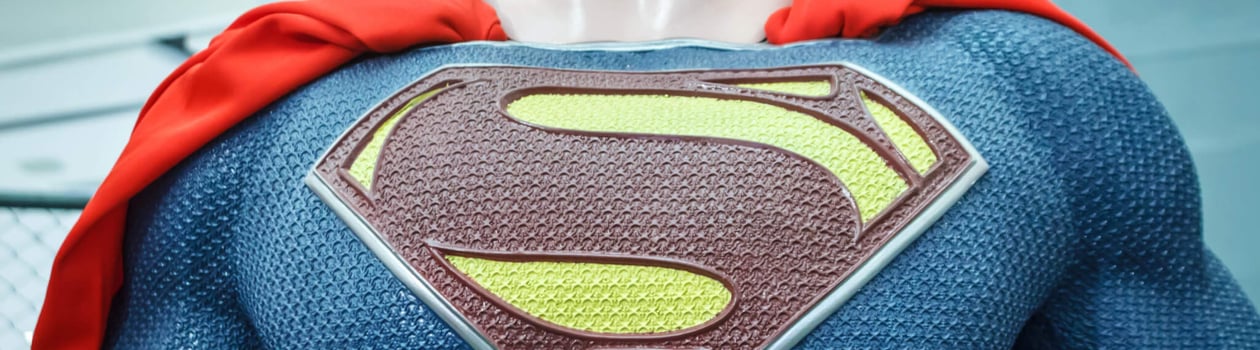
What’s that?! There in the sky? Is it a bird? Is it a plane? No! It’s the Man of Tomorrow! Superman has gone by many names over the years, but one thing has remained the same.
He has always stood for what’s best about humanity, all of our potential for terrible destructive acts, but also our choice to not act on the level of destruction we could wreak. And Superman Day is here to celebrate all of it!
How to Celebrate Superman Day
For those desiring to celebrate Superman Day, there are many options that range from entertaining to altruistic.
Host a Superman Party
One great way to celebrate Superman Day is to host a Superman themed get together with your friends, complete with a cake decorated with the iconic S emblem.
For the dastardly a little green food coloring can change Marshmallow Crispy Bars into Kryptonite bars, and a trampoline in the yard will give everyone a bit of the experience of flying like the Man of Steel. Finish it all off with a marathon of movies, particularly including the one that was instrumental in founding this day, 2013’s Man of Steel.
Embrace the Essence
For those looking to be a bit more altruistic, Superman Day is also a great day to remember what the Man of Steel actually stood for. The Red, White, and Blue of his uniform stood for what made America great, which at that time was a desire for Justice, to help those in need, and a powerful spirit.
Help Someone Else
With those ideas in mind, you could spend your day working at Soup Kitchens, Blood Drives, or a volunteer organization that serves your community. The opportunities to be a little bit “Super” are limitless, just get out there and help your fellow man!
Superman Day Timeline
Siegel and Shuster Conceive Superman
Cleveland teenagers Jerry Siegel and Joe Shuster create an early Superman as a bald telepathic villain, then rework him into a heroic costumed strongman seeking newspaper syndication. [1]
Superman Debuts in Action Comics #1
DC publisher National Allied Publications releases Action Comics #1, featuring Superman’s first published adventure and launching the modern American superhero genre. [1]
The Adventures of Superman Radio Series Premieres
Mutual Broadcasting System airs the first episode of The Adventures of Superman, spreading the character nationwide and soon introducing key elements like Kryptonite and “Up, up and away!” [1]
Fleischer Superman Theatrical Cartoons Begin
The short film “Superman,” produced by Fleischer Studios for Paramount, premieres and wins an Academy Award nomination, showcasing high-budget animation that defines Superman’s early visual style. [1]
Adventures of Superman Television Show Debuts
The syndicated series Adventures of Superman, starring George Reeves, premieres on American TV and becomes many viewers’ first live‑action introduction to the Man of Steel. [1]
Superman: The Movie Opens in Theaters
Richard Donner’s Superman, starring Christopher Reeve, was released and proved a major box office success, demonstrating that superhero stories can work as large‑scale, effects‑driven cinema. [1]
Smallville Reimagines Clark Kent’s Youth
The television series Smallville premieres on The WB, focusing on Clark Kent’s teenage years in Kansas and influencing a wave of grounded, character‑driven superhero TV dramas. [1]
History of Superman Day
Superman was first created in 1933 by Joe Shuster and Jerry Siegel, the writer and artist respectively. His first appearance was in Action Comics #1, and that was the beginning of a long and illustrious career for the Man of Steel.
In his unmistakable blue suit with red cape, and the stylized red S on his chest, the figure of Superman has become one of the most recognizable in the world.
Superman has been through a lot of changes since his initial creation, his original Golden Age incarnation actually being a villainous character that bears absolutely no resemblance to our current hero. Superman as we know and love him today didn’t appear until Action Comics #1, published on April 18, 1938. Such was his success that he got his own comic in 1939, and the world has never looked back since.
Since that time, our boy in blue has seen appearances in every form of media the world has to offer. Comic books, video games, movies, novels, stickers, T-shirts, there isn’t a place that the Man of Steel hasn’t made an appearance.
He’s even been represented in more than one TV show throughout the years, most recently “Smallville”, which retells his time as a youth in the town he grew up in. Examining the Man of Steel during his developmental phases shows him in a rarely seen state of vulnerability, living through the turbulence of adolescence.
As for the celebration of Superman Day, its origins are a bit more recent. In fact, this particular event got started in 2013 as a promotional opportunity for the blockbuster movie by Zack Snyder, Man of Steel. To hype up excitement for the film, DC Comics listed June 12 as “Man of Steel” Day, which later evolved into its current name, Superman Day.
Some folks also choose to celebrate Superman Day on April 18, which is the date of the first release of the comic book character, authored by Jerry Siegel and Joe Shuster, a creative duo from Cleveland.
Superman Day Facts
Kryptonite Was Invented for the Radio, Not the Comics
Kryptonite, now famous as Superman’s chief weakness, did not originate in the comic books.
It first appeared in a 1943 storyline on the “Adventures of Superman” radio show so that voice actor Bud Collyer could take occasional time off while the moaning, weakened hero was portrayed by sound effects. The green mineral did not show up in the comic continuity until several years later.
Superman Helped Sell Millions in U.S. War Bonds
During World War II, Superman was used in U.S. Treasury campaigns to encourage Americans to buy war bonds, particularly targeting children and families.
Comic book covers and stories, as well as radio episodes, explicitly urged readers and listeners to “back the attack” by purchasing bonds and stamps, tying the character’s fictional fight against dictators to real-world financial support for the war effort.
The “American Way” Was Added to His Motto During Wartime
Superman did not originally “fight for truth, justice, and the American way.” Early stories simply emphasized justice and helping the oppressed.
The phrase “the American way” was popularized in the 1940s radio serial and later TV adaptations, where it was added to underscore U.S. patriotism during World War II and the early Cold War, reflecting the era’s political messaging more than the character’s 1930s roots.
Superman’s Early Leaps Reflected 1930s Science, Not Magic Flight
In his earliest comic appearances, Superman could not fly and was described as able to “leap 1/8 of a mile.”
This limitation drew on then-current ideas about human physiology and exaggerated athleticism, presenting his powers as an extension of physical strength rather than outright defiance of physics. Flight was added a few years later, largely for animation and storytelling convenience, and then became a permanent part of the character.
A Jewish Immigrant Subtext Shaped Superman’s Story
Scholars have noted that Superman’s origin as a child sent away from a dying world and raised under a new identity echoes Jewish immigrant and refugee narratives from the early 20th century.
Creators Jerry Siegel and Joe Shuster, both children of Jewish immigrants in Cleveland, embedded themes of exile, assimilation, and moral responsibility that mirrored the hopes and anxieties of Jewish communities in the years leading up to World War II.
Superman’s Look Was Modeled on Circus Strongmen
The classic Superman costume, with trunks over tights and a bold emblem on the chest, developed from real-world circus and vaudeville strongman outfits common in the early 1900s.
These performers wore tight, colorful costumes to show off musculature and advertise their feats, and Siegel and Shuster drew on that visual language so readers would immediately recognize their character as a figure of extraordinary physical power.
Superman Helped Legitimize Comics as Children’s Reading Material
In the 1940s, educators and publishers leaned on Superman stories to promote literacy and citizenship among children.
Special issues and inserts carried lessons on safety, tolerance, and civic responsibility, and teachers reported that the popularity of Superman comics made reluctant readers more willing to pick up printed material, helping comics gain a foothold as an acceptable, if sometimes debated, form of children’s reading.
Superman Day FAQs
What was Superman’s role during World War II?
During World War II, Superman became a symbol of hope and patriotism. Comic covers showed him punching Hitler and dismantling tanks.
The character inspired war bond campaigns, and soldiers read his comics for morale. Superman even encouraged children to support the war effort by collecting scrap metal.
How did a real town become Superman’s official “home”?
Metropolis, Illinois, declared itself Superman’s hometown in 1972.
The city’s dedication includes a 15-foot statue, a Superman museum, and the annual Superman Celebration. Fans worldwide visit this small town, embracing its unique connection to the superhero.
Are there any Superman-inspired Guinness World Records?
Yes, Superman has inspired several records. The largest gathering of people dressed as Superman took place in 2014 in Australia, with 867 participants.
Another notable record is the world’s largest Superman memorabilia collection, owned by Herbert Chavez of the Philippines.
What is the significance of the “S” shield beyond Superman’s name?
The iconic “S” shield evolved from simply standing for “Superman” to a Kryptonian symbol of hope.
In the 2003 comic storyline, it was revealed to represent the House of El, Superman’s family crest, symbolizing resilience and perseverance.
Why is June 12 a fitting date for Superman Day?
June 12 was chosen in 2013 to coincide with the release of the movie Man of Steel.
However, it also aligns with Superman’s summer debut in Action Comics in June 1938. The timing reflects both his origins and modern relevance.
How did Superman influence the superhero genre?
Superman set the template for superheroes, creating the archetype of the cape-wearing, morally upright hero. His success in Action Comics led to the creation of Batman, Wonder Woman, and others, forever shaping popular culture.
What role did Superman play in education?
In the 1940s, Superman became a tool for education. Comics included safety messages and lessons about citizenship. Schools used him as a teaching aid to engage children in reading and learning moral values.
What are some myths about Superman’s powers?
Many believe Superman was always capable of flight, but early comics only showed him leaping great distances.
His ability to fly was added in the 1940s due to advancements in animation. Another myth is that Kryptonite was a comic creation; it was introduced in a 1943 radio show.
How has Superman’s appearance evolved over time?
Superman’s iconic look has changed with the times. His original costume had a more circus-strongman vibe.
Over decades, artists adjusted his appearance to reflect contemporary styles, including sleeker suits and variations on the “S” shield.
What are some unusual ways fans celebrate Superman Day?
Fans hold themed charity events, like “Superman Runs” where participants dress as the hero.
Others create elaborate Kryptonian-inspired art or cosplay. In Metropolis, Illinois, couples have even held Superman-themed weddings during the celebration.



You may also like
National Comic Book Day
Read some comic books or enjoy any of the many television adaptations of comic book characters, from Marvel to DC and more, on National Comic Book Day.
- Canada
- Japan
- United Kingdom
- and 1 more

Free Comic Book Day
Dive into a new world, or revisit an old favorite by supporting your local comic book store and the people who create such magnificent worlds and characters.
- Australia
- Canada
- United Kingdom
- and 1 more

Amateur Radio Military Appreciation Day
Amateur Radio Military Appreciation Day unites hams and communities to honor military, veterans, and first responders with live on-air messages of gratitude.

National Radio Day
With radio, you can hear stories, music, news, and voices from faraway places, bringing the world together in a powerful and immediate way.
National days and holidays on June 12

Vivid Sydney
Vivid Sydney is a dazzling celebration that transforms the city into a vibrant playground of lights, music, and creativity. For weeks, iconic landmarks and urban spaces glow with stunning light installations and 3D projections, captivating both locals and tourists. This festival draws millions of visitors each year, offering an enchanting...

National Red Rose Day
Celebrate National Red Rose Day by honoring the timeless symbol of love, exploring rose gardens, sharing blooms, and starting heartfelt romantic traditions.
- Australia
- Canada
- United Kingdom
- and 1 more

Peruvian Hairless Dog Day
Celebrate Peruvian Hairless Dog Day by honoring Peru’s native hairless breed, a national treasure symbolizing heritage, loyalty, and a deep human–canine bond.

National Great Dane Day
Discover the gentle, loyal nature of Great Danes on National Great Dane Day, celebrating these towering companions and promoting their care, adoption, and respect.
Seize Every Day
Join free for personalised recommendations, email reminders and exclusive guides. Never miss a day.