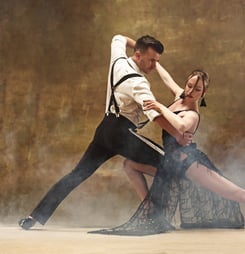

For those who have been thinking that there just aren’t enough reasons to cavort around a dance floor to the boisterous sounds of 1920s jazz, then you will no doubt become a fan of World Lindy Hop Day.
After a decline in popularity in the 1950s, this form of swing music is back and infecting more and more followers with its undeniable vitality!
World Lindy Hop Day Timeline
Shorty George Snowden Coins the Name “Lindy Hop”
During a dance marathon at the Manhattan Casino in New York, Harlem dancer “Shorty” George Snowden reportedly describes his new breakaway-style dance as the “Lindy Hop,” helping to give the emerging form its lasting name.
Savoy Ballroom Opens in Harlem
The Savoy Ballroom opens on Lenox Avenue in Harlem with a large, polished double dance floor and a house band, quickly becoming an epicenter of African American social dance and the main laboratory where Lindy Hop develops.
Whitey’s Lindy Hoppers Formed
Savoy bouncer and promoter Herbert “Whitey” White organizes the best Lindy Hop dancers into the professional troupe Whitey’s Lindy Hoppers, which brings the dance from Harlem ballrooms to stage, film, and international tours.
Frankie Manning Introduces the Air Step
Frankie Manning debuts one of the first aerial “air steps” in competition at the Savoy Ballroom, revolutionizing Lindy Hop with acrobatic lifts that become a signature of performance swing dancing.
“Hellzapoppin’” Captures Lindy Hop on Film
The film “Hellzapoppin’” features Whitey’s Lindy Hoppers in a celebrated sequence showcasing lightning-fast swing-outs, aerials, and ensemble precision, becoming one of the most referenced visual records of authentic Lindy Hop.
Lindy Hop Spreads Internationally During World War II
As American troops are stationed abroad during World War II, social dances and interactions with locals help carry Lindy Hop and swing music across Europe and beyond, laying foundations for postwar scenes.
Global Swing Revival Renews Lindy Hop
A swing dance revival in the United States and Europe, including events like the Herräng Dance Camp in Sweden and workshops led by original Harlem dancers such as Frankie Manning, sparks renewed worldwide interest in Lindy Hop.
How to Celebrate World Lindy Hop Day
Have a load of high energy fun by celebrating World Lindy Hop Day with a partner or a group of friends. Consider some of these ideas for making plans to enjoy the day:
Try the Lindy Hop
For those who want a true experience on World Lindy Hop Day, it might be fun to try to seek out a venue with live big-band jazz. It’s fun, frenetic, occasionally frenzied, and is likely to leave the participants feeling exhausted! But don’t worry: it only needs to be done once every year.
Even better, though, because dancing is such good exercise, join a group of dancers that does the Lindy Hop and other dances as a way to stay in shape and enjoy life a bit more on a regular basis!
Visit Harlem in New York
Have a cultural experience by visiting the place where the Lindy Hop and other swing dances were started! Harlem, New York, offers a unique perspective on the history and background of not only the dances but the African American culture that was a vital pillar for the style of the era.
It’s even possible to book a special tour that is specifically cultivated to reveal the unique history of the Harlem Swing Dances, including the Lindy Hop.
One important event of the day would be to visit the site of where the Savoy Ballroom used to be, the iconic place where all of this got started. So perhaps it would be fun to book and enjoy a special tour of Harlem in celebration of World Lindy Hop Day!
Watch Some Old Movies with Lindy Hop
One interesting activity in honor of World Lindy Hop Day might be to try to catch some Lindy Hop dances on classic films. Check out some of these old movies to get a taste of what the dance was like at the time:
- A Day at the Races (1937) with the Marx Brothers
- Hellzapoppin’ (1941) with Ole Oleson and Chic Johnson
- Buck Privates (1941) with Bud Abbott and Lou Costello
History of World Lindy Hop Day
The history of World Lindy Hop Day begins with this energetic dance that originated in black communities in Harlem, in New York City back in the early 20th century.
This form of swing dancing is characterized by its opportunities for free form expression by the participants, offering plenty of time and space for unique movements that are improvised and stylized in a wide variety of ways.
The influences for the high energy Lindy Hop during these early days of the Harlem Renaissance were jazz music and dance, as well as other forms of dance such as The Charleston, tap and breakaway.
The creation of the dance during the swing era stems from influences of African American music and culture as well as European partnered dances.
Some say that the name of this dance, the Lindy Hop, commemorates an important historical event that took place around this same time.
That is, none other than American aviator Charles Lindbergh’s 1927 ‘hop’ across the Atlantic in a plane – the first time that feat was accomplished alone – but let’s hope he wasn’t doing this dance when he was at the controls!
World Lindy Hop Day was established to commemorate dancer and choreographer, Frankie Manning, who many people consider to be one of the main creators of this unique style of dancing.
The day is celebrated in honor of Frankie Manning’s birthday on May 26, 1914. The inugural celebration took place in 2014, on what would have been his 100th birthday.
Facts About World Lindy Hop Day
Savoy Ballroom as a Rare Integrated Social Space
Opened in 1926 in Harlem, the Savoy Ballroom became famous not only for its dancers and bands but also for being one of the few major ballrooms in the United States that was racially integrated from the start, with Black and white patrons dancing together on the same floor at a time when segregation was still widespread in public venues.
The “Swingout” and the Eight-Count Structure
A defining feature of Lindy Hop is the “swingout,” an eight-count move in which partners trade places around a circular pathway, blending elements of closed and open position.
This step helped distinguish Lindy Hop from earlier social dances that relied more heavily on fixed patterns and closer holds, and it became the foundation for much of the dance’s improvisation and styling.
Whitey’s Lindy Hoppers and Global Fame
The performance troupe Whitey’s Lindy Hoppers, formed in the 1930s by Savoy Ballroom bouncer Herbert “Whitey” White, helped turn Lindy Hop into an international phenomenon.
The group toured widely, appeared in Hollywood films such as “Hellzapoppin’” in 1941, and showcased high-flying aerial steps that influenced later stage and street dance styles.
World War II and the Spread of Swing Dancing
During World War II, American servicemembers carried Lindy Hop and related swing dances to military bases and cities across Europe, North Africa, and the Pacific.
Informal dances, USO shows, and interactions with local civilians helped seed swing scenes abroad, which later evolved into distinct regional traditions in countries such as the United Kingdom, France, and Sweden.
Lindy Hop’s Roots in African American Vernacular Dance
Lindy Hop grew out of African American vernacular dance traditions that emphasized rhythm, improvisation, and call-and-response with the music.
It drew from earlier forms like the Charleston and “breakaway,” in which partners separated to improvise solo steps before rejoining, reflecting a long lineage of African diasporic movement styles in the United States.
Norma Miller, the “Queen of Swing”
Norma Miller, often called the “Queen of Swing,” was discovered dancing outside the Savoy Ballroom as a teenager and went on to join Whitey’s Lindy Hoppers, tour internationally, and later choreograph and act.
Her memoirs and interviews have become key primary sources documenting the lived experience of Lindy Hop dancers during the swing era.
The 1980s–1990s Swing Revival and Archival Rediscovery
A major swing dance revival in the 1980s and 1990s led younger dancers and historians to seek out original Lindy Hop pioneers, study archival film, and reconstruct forgotten steps.
Events such as the Herräng Dance Camp in Sweden became hubs where surviving dancers like Frankie Manning taught new generations, helping to reestablish Lindy Hop as a living, evolving social dance rather than a relic of the big band era.