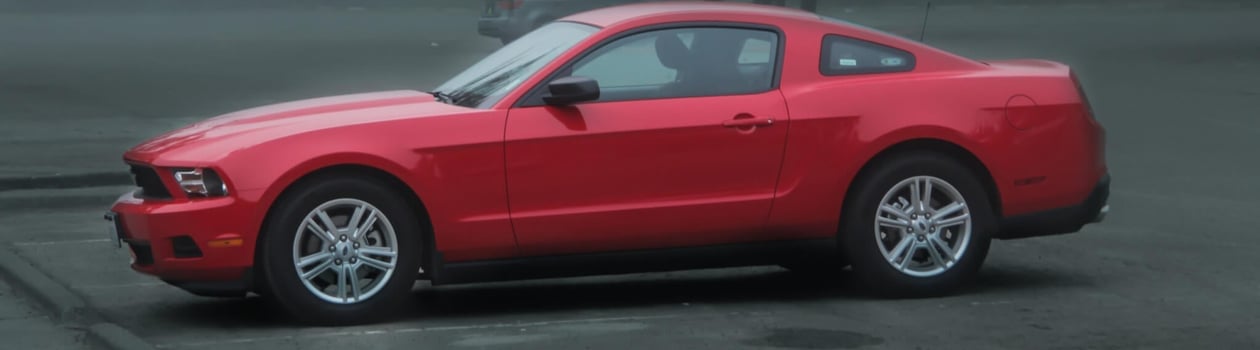
It’s got sleek lines and a powerful engine, its name speaks of wild places and adventurous times. For generations it was the car of choice for action heroes and spies alike, even James Bond drove one in Goldfinger.
For some it was the very flavor of summer sunsets and nighttime drives on youth’s misadventures, but it always brought them home safely.
We’re talking about the Ford Mustang, of course, and National Ford Mustang Day celebrates this incredible and iconic piece of American engineering.
Celebrating National Ford Mustang Day
All over the country (and indeed, all over the world) festivals and celebrations are held that honor this vehicle. 60 years of different models of this line are brought out by enthusiasts, most maintained in impeccable shape, standing as an icon of their time.
You can find these with a simple web search, and then go out and see the march of time and technology as it reshaped the overall appearance of the Mustang while leaving its underpinning sense of aesthetic and purpose untouched.
National Ford Mustang Day presents an opportunity to really appreciate what American Engineering can do, and how a car can change the face of the automotive industry.
National Ford Mustang Day Timeline
Mustang I Concept Car Debuts
Ford unveiled the mid‑engine Mustang I concept at the U.S. Grand Prix in Watkins Glen, signaling its interest in a lightweight, sporty car aimed at younger buyers and serving as a design and marketing test bed.
Ford Mustang Public Launch
Ford introduced the Mustang at the New York World’s Fair and simultaneously in dealerships nationwide, selling over 22,000 cars on the first day and redefining expectations for affordable performance cars.
Birth of the Pony Car Segment
Automotive journalists began using the term “pony car” to describe the Mustang’s new class of compact, stylish, affordable performance coupes, soon inspiring rivals like the Chevrolet Camaro and Plymouth Barracuda.
“Bullitt” Cements the Mustang Legend
The film “Bullitt” features Steve McQueen driving a Highland Green 1968 Mustang GT 390 in an influential San Francisco car chase, cementing the Mustang’s image as a performance icon in popular culture.
Oil Crisis Drives Mustang II Redesign
In response to the 1973 oil crisis and changing regulations, Ford developed the smaller, more fuel‑efficient Mustang II for the 1974 model year, trading raw power for practicality and strong sales in a new economic era.
“Boss is Back” and the Return to Performance
Ford reintroduces a performance‑oriented Mustang GT with a 5.0‑liter V‑8 and “The Boss is Back” advertising, helping lead a broader 1980s revival of American muscle and restoring the car’s performance reputation.
Sixth‑Generation Mustang Goes Global
Ford launches the sixth‑generation Mustang with independent rear suspension and, for the first time, official right‑hand‑drive production, transforming the Mustang from an American specialty car into a global performance model.
History of National Ford Mustang Day
The Ford Mustang was first introduced to the world in April of 1964. The World’s Fair was in full swing, and this car was Ford’s introduction as the car of the future.
This introduction of the Mustang also was the introduction of the first Pony Car, to wit, a line of small sporty cars with sleek lines and an affordable price-tag.
Sales of the Mustang proved that this car was going to become an American favorite, with well over 400,000 sales in the first year it was in production, an unprecedented success for an unprecedented vehicle.
The muscle car of the time was the Thunderbird, and that beauty was the one that every serious sports car fanatic wanted to own. The Mustang came into existence with the idea not of replacing that vehicle, but instead putting its like within reach of the working class.
Such was its popularity that over 500 clubs celebrating the Mustang came into existence within just 3 years of its release. This is the kind of fanaticism that’s usually saved for classic cars, but the Mustang just rolled right in and took its place as a new classic right off the bat.
Such was the popularity of the Mustang that 60 years later, over 9 million of them have been sold. National Ford Mustang Day celebrates this vehicle that came out of nowhere to become an American institution.
How Volunteering Empowers Girls and Shapes Their Development
Volunteering plays a powerful role in shaping girls’ academic success, emotional well-being, and social confidence.
Research highlights that girls who engage in service early are more likely to achieve higher education levels, build stronger social connections, and develop a deeper sense of purpose.
From improving self-esteem to strengthening community ties, these experiences show that volunteering is not just an act of giving—it is a pathway to personal growth and lifelong impact.
The Secret Falcon Roots of the Original Mustang
The first-generation Mustang looked radically new, but underneath it shared much of its hardware with the compact Ford Falcon to keep costs low and speed development.
Engineers used modified Falcon unibody structures, suspension components, and drivetrains, then wrapped them in a sporty body and interior.
This parts-bin strategy helped Ford hit an accessible price point while still creating a car that felt fresh enough to launch an entirely new “pony car” segment.
How the Mustang Helped Invent “Segment Marketing” in Detroit
Ford’s launch of the Mustang is often cited as a turning point in automotive marketing, because it was aimed at a psychographic group rather than a traditional demographic.
Instead of focusing on age or income alone, Ford targeted buyers who saw themselves as youthful, independent, and style-conscious, and backed this up with an unusually broad list of factory options so no two cars had to be alike.
This approach became a template for future car launches across the industry.
Mustang’s Role in the Birth of the Modern Car Movie Chase
The 1968 film “Bullitt” used a Highland Green Mustang GT 390 in a nearly 10-minute chase through San Francisco that heavily influenced how car chases were shot and edited.
Director Peter Yates and star Steve McQueen pushed for realistic speed, minimal music, and on-location filming, which made the Mustang’s on-screen performance feel raw and visceral.
Film scholars still point to “Bullitt” as a watershed moment that set the standard for action sequences built around real cars and practical stunts.
From Pony Car to Global Halo Model
For decades, the Mustang was sold almost entirely in North America, but Ford’s 2015 redesign intentionally engineered it for right-hand drive and international regulations so it could be sold as a global model.
That change opened markets like the United Kingdom, Australia, and parts of Asia, where American performance cars had historically been niche gray imports at best.
Within a few years, the Mustang became one of the world’s best-selling sports coupes, turning a once-regional icon into a global halo car for the brand.
How the Mustang Shaped Safety and Emissions Technology
As regulations tightened in the 1970s and beyond, the Mustang became a rolling testbed for new safety and emissions technologies that would spread across Ford’s lineup.
Successive generations adopted features like catalytic converters, electronic fuel injection, airbags, and advanced crumple zones to meet changing rules without abandoning performance entirely.
The car’s popularity gave Ford an incentive to refine these systems early, helping normalize cleaner, safer technology in mass-market vehicles.
Mustang Clubs as Grassroots Preservation Networks
Independent Mustang clubs that sprang up across the United States and overseas evolved into informal preservation networks for the model’s history and hardware.
These clubs organize parts swaps, technical workshops, and judged shows that encourage factory-correct restorations and careful documentation of rare options and trim levels.
Historians and archivists often rely on club registries and newsletters as sources when reconstructing production details that were never fully preserved in corporate records.
The Mustang’s Influence on Rivals in the Pony Car Wars
The runaway success of the Mustang in the mid-1960s pushed American competitors to create direct rivals, triggering what enthusiasts call the “pony car wars.”
General Motors answered with the Chevrolet Camaro and Pontiac Firebird, Chrysler followed with the Dodge Challenger and Plymouth Barracuda, and American Motors offered the Javelin, all adopting the long-hood, short-deck formula with sporty styling at relatively attainable prices.
This competitive burst reshaped Detroit’s product planning for years, cementing the pony car as a distinct and enduring category.