
Global Work From Home Day, observed annually, highlights the perks of telecommuting. It encourages employers and employees to try remote working and appreciate its benefits.
This special day promotes the flexibility, discipline, and responsibility needed to work effectively from home. It is celebrated because many jobs do not require physical presence in an office.
How to Celebrate Global Work From Home Day
Redefine Your Workspace
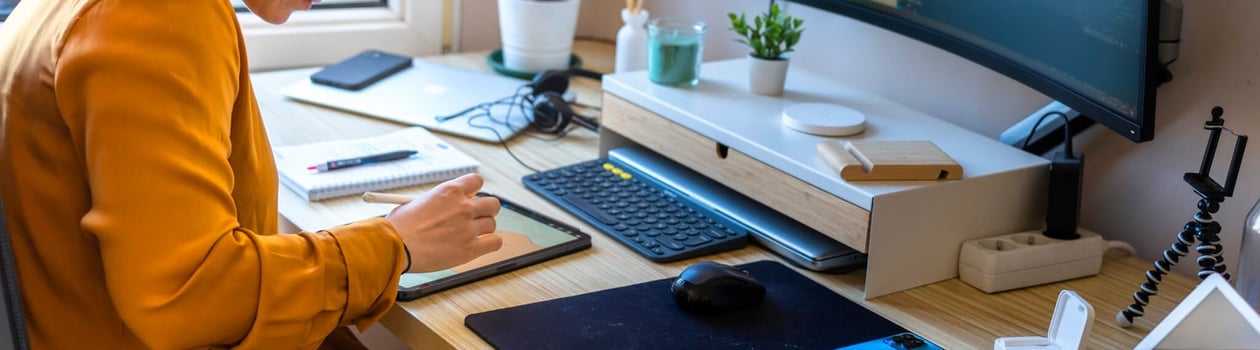
Spruce up a home office, kitchen corner, or whatever spot doubles as “headquarters” for the day. A refreshed workspace is not just about looking nice on a video call. It can make work feel more intentional, which matters when the commute is a stroll from the bedroom.
Start with the basics: lighting, comfort, and clutter. Moving a desk closer to natural light can reduce eye strain. Adding a lamp with a warmer bulb can make evenings feel less like working in a cave. Tidying cables, clearing paper piles, and giving frequently used items a dedicated home can cut down on tiny interruptions that add up.
It also helps to think ergonomically, even without fancy gear. A chair that supports the lower back, a screen positioned closer to eye level, and a keyboard setup that keeps wrists neutral can make a long day feel dramatically better.
If a laptop is the only option, propping it on a stable stack of books and using a separate keyboard can turn “good enough” into “actually comfortable.” A small footrest, even an upside-down storage bin, can help posture.
Then come the fun touches: a plant, a quirky pen cup, a small piece of art, or a mug that makes the daily routine feel less like a grind. The goal is a space that signals, “Work happens here,” but still feels like part of a home.
Go Social
Share a home office setup on social media using the hashtag #WorkFromHomeDay. It is a simple way to swap ideas, compare setups, and laugh kindly at the reality that many people work three feet away from a laundry basket.
For a more useful twist, share one thing that makes remote work smoother: a favorite focus playlist, a noise-canceling hack, a daily schedule that actually sticks, or a tool that helps manage tasks. People often show the aesthetic side of a workspace, but practical tips are what make others say, “That is smart. I’m stealing that.”
Those who prefer not to post publicly can still “go social” in smaller circles. Sharing a quick photo or description in a team chat can spark conversation and help remote colleagues feel more connected. It can also normalize the fact that everyone’s setup is different, and perfection is not the point.
Dress for Success
Who says work-from-home clothes have to be the same old rotation of hoodies and “camera-off comfort”? Dressing for success at home is less about formalwear and more about choosing an outfit that supports the kind of day someone wants to have.
Some people feel sharper in business casual. Others do better with a “uniform” that separates work hours from personal time, even if the uniform is clean jeans and a favorite sweater. The trick is to pick something that signals “on the clock” without sacrificing comfort.
A fun approach is to choose a theme: bright colors, a bold pattern, or an accessory that would feel over-the-top in a cubicle. It adds a bit of celebration to an otherwise normal workday. For those who enjoy sharing, snapping a photo can be a lighthearted nod to the day, especially if the outfit includes “professional on top, cozy on the bottom” energy.
Virtual Hangout
Organize a virtual coffee break or end-of-day hangout with colleagues. Remote work is efficient, but it can also be oddly quiet. The spontaneous chats that happen in hallways or while waiting for a meeting to start do not always appear on their own in digital spaces, so creating them on purpose can help.
Keep it short and low-pressure. A 15-minute coffee chat can be enough to restore a sense of team rhythm without turning into another meeting that eats the day. Some teams like prompts to avoid awkward silence: “Show an object on your desk,” “What is a small win from this week?” or “What is one non-work thing you are looking forward to?”
For distributed teams across time zones, rotating the time can help everyone feel included. It also helps to make it genuinely optional. The goal is connection, not obligation.
Learn and Grow
Take a short online course, watch a webinar, or do a focused skill refresh connected to the job. Remote work often requires stronger self-management and clearer communication than office work, so learning can be both practical and immediately useful.
Professional development does not have to be a major commitment. It could be a short tutorial on a spreadsheet feature, a refresher on writing clearer emails, a deep dive into accessibility practices for documents, or a training session on giving better feedback in written form. Even learning about cybersecurity basics, like spotting phishing messages and using a password manager, is a valuable investment for anyone working outside a traditional office.
Growth can also mean improving the remote routine itself. Experimenting with a new planning method, trying time-blocking, or setting up better notification rules can reduce mental clutter. If the work involves collaboration, learning how to run better virtual meetings, write stronger agendas, or document decisions clearly can make a noticeable difference for an entire team.
Each of these activities offers a light-hearted and enjoyable way to celebrate Global Work From Home Day. They foster a sense of community and personal growth while you enjoy the comforts of your home office.
Why Celebrate Global Work From Home Day?
Advancements in technology have made it easier to work effectively from remote locations, reducing the need for daily commutes and allowing a better balance between work and personal life. People can manage their tasks with the same efficiency at home as they would in an office setting.
But the real appeal of Global Work From Home Day is that it treats remote work as a craft, not an accident. Working from home well usually involves deliberate choices: how to structure the day, how to communicate, how to protect focus, and how to build a healthy separation between professional and personal life.
One of the most obvious benefits is time. Commuting can swallow hours that could otherwise go to sleep, exercise, caregiving, hobbies, or simply starting the day without rushing. Many remote workers also find they can concentrate more deeply at home, especially for tasks that require uninterrupted attention. Without the constant background interruptions of a busy workplace, some people enter long stretches of productive flow.
Remote work can also broaden opportunities. It may allow employers to hire talent beyond a single region and help people with differing needs thrive, including those who work best in quieter spaces or those who need flexibility to manage health considerations. For employees, it can mean more autonomy over the work environment, from temperature to noise levels to the ability to take a quick stretch break without feeling watched.
The day is particularly significant because it recognizes the changing dynamics of work environments. With a growing number of people preferring to work from home, this day helps highlight the positive impacts, such as increased productivity, better work-life balance, and decreased employee turnover.
At the same time, celebrating the day does not require pretending remote work is perfect for everyone or every role. Many jobs depend on physical presence, hands-on collaboration, or specialized equipment. Even for desk-based work, home environments vary widely. Some people have dedicated offices, while others share space, share bandwidth, or share attention with children, roommates, or pets that have very strong opinions about being ignored.
Global Work From Home Day can be a useful moment for teams to talk about what makes remote work sustainable. That might include clearer expectations around availability, fewer meetings that could have been messages, and better documentation so people are not disadvantaged when they are not “in the room.”
It can also highlight the importance of mental health practices, like setting a real end to the workday, taking breaks, and building social connection on purpose.
For employers, the day is a chance to think like a systems designer. Remote work succeeds when organizations invest in good onboarding, strong communication norms, and tools that support collaboration without turning every interaction into a video call.
It also succeeds when performance is measured by outcomes instead of visibility. When people are judged by what they deliver, not by whether their status light is green, trust becomes the foundation of productivity.
For employees, it can be a chance to tune the small habits that make remote work feel less chaotic. Managing notifications, planning the day in advance, and creating a “shutdown ritual” can prevent work from leaking into every corner of life. Even tiny steps, like stepping outside for five minutes or eating lunch away from the screen, can make a work-from-home routine feel more human.
It encourages those who haven’t yet embraced this model to consider its advantages, while also inviting a realistic look at what it takes to do it well.
Global Work From Home Day Timeline
Jack Nilles Coins “Telecommuting”
Former NASA engineer Jack Nilles leads a telecommuting pilot for a Los Angeles insurance company and begins using the term “telecommuting” to describe working remotely instead of commuting by car.
Publication of Early Telecommuting Research
Jack Nilles and colleagues publish research on “telecommuting” and “telework,” outlining how telecommunications could substitute for daily travel and reduce traffic congestion and energy use.
IBM Lets Employees Work from Home
IBM begins allowing some employees to work from home on a regular basis, one of the earliest large corporate telecommuting programs, signaling that remote work can function at enterprise scale.
Creation of the U.S. Federal Telework Pilot
The U.S. Office of Personnel Management and General Services Administration launched a small telework pilot, gradually expanding remote options for federal employees through the 1990s.
Commercial Internet and VPNs Enable Remote Work
The spread of commercial internet access and virtual private networks in the mid‑1990s gave office workers secure remote access to corporate systems, making routine work from home technically feasible.
U.S. Congress Encourages Federal Telework
Congress passes the Department of Transportation and Related Agencies Appropriations Act, requiring certain federal agencies to establish telework policies and increasing formal support for working from home.
Telework Enhancement Act Formalizes U.S. Policy
The Telework Enhancement Act of 2010 was signed into law, requiring federal agencies to identify telework-eligible positions and integrate telework into continuity and workforce planning.
History of Global Work From Home Day
Global Work From Home Day marks an important event dedicated to promoting the advantages of working remotely.
Launched in 2019 by Remote-how, a non-profit organization, this day has grown to become a significant occasion for employees and employers around the world to appreciate and embrace the flexibility of home-based work environments.
The timing makes sense. By the late 2010s, remote work had already shifted from a niche arrangement to a mainstream option in many industries. Cloud-based software, faster home internet, and collaboration tools made it possible for distributed teams to work together in real time.
Video conferencing improved, project management platforms became common, and companies began to realize that work was something people did, not necessarily a place they went.
Global Work From Home Day fits into that broader story by focusing attention on remote work as a legitimate, structured way of working. It encourages a test-and-learn attitude: try it, observe what works, and adjust. For some organizations, that might mean experimenting with a fully remote day. For others, it could be formalizing hybrid practices so remote employees are not treated like second-class teammates.
The roots of what is now celebrated as Global Work From Home Day can be traced back to the early discussions and implementations of telecommuting. The concept of telecommuting was coined in the 1970s by Jack Nilles during his time working on future-focused projects tied to transportation and communications, a period when researchers were considering how technology might reduce traffic congestion and energy use.
The initial idea was surprisingly practical: if information could travel instead of people, then some work could happen closer to home. At the time, the necessary tools were limited. Early telecommuting relied on phone calls, paper files, and slow data connections. Still, the concept sparked interest because it reframed work in a new way. It suggested that productivity could be separated from a specific building.
As computers became more common and businesses digitized their processes, telecommuting became more plausible. By the 1990s, remote work had become a recognizable work style, discussed widely in business and academic circles.
Companies experimented with flexible schedules, satellite offices, and early forms of remote access. Laptops improved, email became standard, and the idea of “working from anywhere” started to sound less like science fiction.
In the decades that followed, the shift accelerated. Broadband internet became widely available, smartphones turned communication into a constant, and cloud services made it possible to access files and tools from nearly any device.
More importantly, workplace culture started to change. Knowledge work increasingly emphasized collaboration across departments, regions, and sometimes continents, and remote tools were built to keep up.
Global Work From Home Day reflects all of that progress, while also nudging the conversation toward quality. Working from home is not simply a matter of moving the same tasks to a different room. It often requires different skills: written communication that is clear and friendly, meeting etiquette that respects time zones and attention, and a level of self-direction that is not always taught in traditional workplaces.
The celebration of Global Work From Home Day highlights the ongoing shift toward more flexible work arrangements and the technological and social changes that have enabled it.
It also serves as a reminder that remote work works best when it is thoughtfully supported, whether that support comes from a company investing in better processes or from individuals setting up routines that protect both productivity and personal well-being.
Working From Home Has a Long History and a Modern Revival
The First Telecommuting Experiments Were Driven by Traffic and Energy Concerns
In the early 1970s, former NASA engineer Jack Nilles led one of the first formal telecommuting experiments in Los Angeles as a way to reduce traffic congestion and energy use during the oil crisis.
Employees of an insurance company worked from satellite offices closer to home, with results showing reduced commute times and comparable productivity, helping establish telecommuting as a serious urban-planning and management strategy rather than just a technological novelty.
Home-Based Work Predates the Modern Office by Centuries
Long before laptops and video calls, “working from home” was the dominant economic model for many households.
In early modern Europe and North America, putting-out systems and cottage industries had textile workers, shoemakers, and other artisans carrying out production in their homes, coordinated by merchants who supplied raw materials.
Industrial factories and later corporate offices gradually pulled this work out of the home, so today’s remote-work trend in some ways revives an older pattern of domestically based labor.
Remote Work Was Growing Steadily Long Before the Pandemic
Well before COVID‑19, remote work was on the rise. The U.S. Census Bureau reported that the share of workers primarily working from home grew from 3.3 percent in 2000 to 5.2 percent in 2017, an increase of roughly 3 million people.
By 2019, the U.S. Bureau of Labor Statistics found that nearly a quarter of employed people did at least some work from home on a given day, reflecting broader adoption of telecommuting technologies and flexible work policies.
Knowledge Work Is Especially Suited to Remote Arrangements
Occupations that rely mainly on information processing, such as software development, finance, and many professional services, are far more likely to be performed from home than jobs requiring in-person physical tasks.
Research by economists Jonathan Dingel and Brent Neiman estimated in 2020 that about 37 percent of U.S. jobs could be done entirely at home, with higher feasibility in sectors like IT, education, and management, and very low feasibility in industries such as hospitality, retail, and manufacturing.
Telework Can Raise Productivity Under the Right Conditions
A landmark randomized study at a Chinese travel agency found that call center employees who volunteered to work from home increased their productivity by 13 percent compared with office-based colleagues.
The researchers attributed this to quieter working environments and reduced breaks and sick days.
When the company later gave workers a choice of where to work, productivity rose even further among those who selected the arrangement that best fit their preferences.
Remote Work Can Reduce Turnover and Office Costs
Organizational studies have found that allowing employees to work from home can significantly reduce staff turnover and overhead expenses.
In the same Chinese travel agency experiment, the home-based workers’ attrition rate fell by about 50 percent relative to the control group, and the company saved an estimated $2,000 per remote worker per year in office space and related costs.
These findings have encouraged many employers to view remote work policies as a strategic tool rather than just a perk.
Telecommuting May Help Cut Greenhouse Gas Emissions
By eliminating or reducing daily commutes, remote work can contribute to lower transportation-related emissions, which are a major source of greenhouse gases.
A 2020 analysis by the International Energy Agency noted that if employees who can work from home did so just a few days per week, it could meaningfully reduce oil demand and urban air pollution, provided that increased home energy use and non-work travel do not offset the gains.
Policymakers increasingly view telecommuting as one tool among many for meeting climate goals.