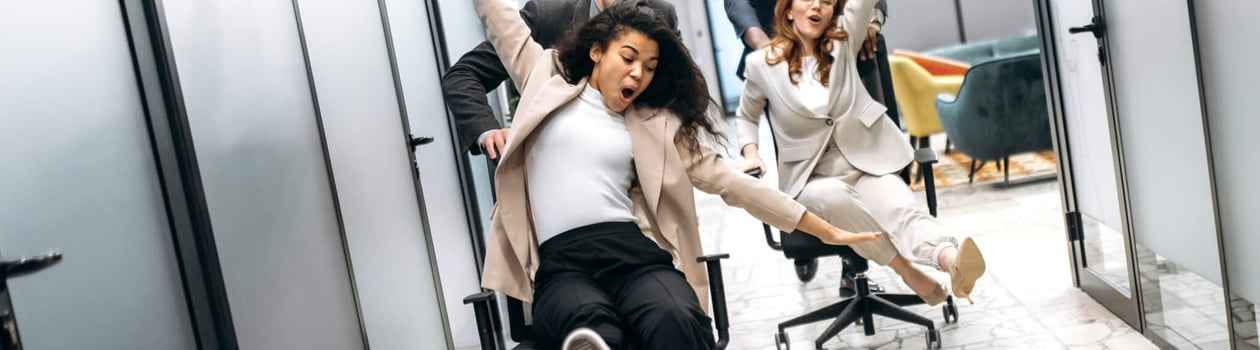
For some people who happen to absolutely love their jobs, every day at work can be fun.
But for many people whose work might be a bit tedious or less than joyful, they need some pick-me-up days throughout the year to keep things lively and make the days pass a bit more quickly.
International Fun at Work Day is just one such time of the year when working and having fun are meant to collide!
How to Celebrate International Fun at Work Day
A day that can be filled with all sorts of delight, International Fun at Work Day provides a wide array of opportunities for celebrating. Get involved with the day and participate with some of these fun ideas:
Throw a Party at Work
One of the best ways to celebrate International Fun at Work Day is to enjoy a party with coworkers. After all, how can the boss say no to a party that is sanctioned by this official day?
For those companies that will give a little budget for International Fun at Work Day, perhaps have some food catered in or go out to lunch together. Perhaps get permission to screen a movie, host a quiz or trivia hour, or make it into a dress up day.
Those who don’t have a budget can still organize a party in advance by having coworkers bring a variety of food, baked goods, desserts and other delicious items to share, eat and enjoy. Have food set out in the employee breakroom or shared throughout the office.
Learn Fun Facts About Fun at Work
One special way to celebrate International Fun at Work Day might be to get more information about the scientific facts behind having fun. Job satisfaction is a vitally important factor for employers, so managers and bosses would do well to keep apprised of these tidbits:
There is a 9% overlap between how much a person loves their job and how well they perform at it.
A positive relationship exists between how much fun people have at work and how good of a team player they are. Fun creates niceness, which can avoid a toxic workplace.
Small teams tend to outperform solo geniuses, so creating a fun working environment can help with team dynamics.
Listening to the right music can help people get work done faster, so be sure to make those tunes at work super fun.
Raise Funds for Charity
One super way to celebrate International Fun at Work Day might be to have tons of fun but also make it helpful in support of a good cause.
Host some games or a raffle that can raise money for those who struggle with food insecurity or unemployment.
Make it an office dress down day where everyone can donate a dollar to wear jeans or casual wear. And those who have the support of their company can even host a matching-gift day where the employer provides equal donations for every dollar donated by the employees.
Take a Field Trip
Many companies offer a quarterly fun day or afternoon away from the office, so International Fun at Work Day would be a great time to cash in on this day.
Take an afternoon out at the park if the weather is warm enough, and enjoy some outdoor games like cornhole or croquet. Indoor fun can be had with a Family Feud style game or letting employees participate in a bake-off or chili cook-off.
There are loads of creative ways to celebrate having fun at work!
Provide Volunteer Opportunities
Those who would rather donate their time can devise a plan for an employee volunteer day at work. Celebrate International Fun at Work Day by sharing in the fun with others in the local community.
Volunteer to clean up a local park or highway, help at an animal shelter, or serve at a soup kitchen. It’s a great day to make the world a better and more fun place!
International Fun at Work Day Timeline
Early Factory Owners Organize Works Outings
Some of the earliest industrial employers in Britain begin sponsoring annual “works outings” and excursions, giving factory workers rare chances to socialize and relax together away from the mill.
Shorter Hours and the Idea of Time Off
Campaigns for a ten-hour and later eight-hour workday in Britain and the United States link reduced hours with moral and social benefits, helping to create space for leisure and enjoyment outside and eventually around work.
Eight‑Hour Day Movement Gains U.S. Momentum
The National Labor Union in the United States formally calls for an eight-hour workday, reinforcing the principle that humane hours are essential not just for health and wages but also for rest, family life, and recreation.
Company Picnics and Social Clubs Spread
Industrial firms in Europe and North America increasingly sponsor picnics, sports teams, and social clubs for employees, reflecting an early belief that organized fun and camaraderie can improve morale and loyalty.
Welfare Capitalism Promotes Workplace Recreation
Large American corporations adopt “welfare capitalism,” building recreation facilities, sports leagues, and social events for employees in an effort to reduce labor unrest and foster a more cheerful, cooperative workforce.
Organizational Psychology Studies Job Satisfaction
As organizational psychology develops, researchers begin systematically examining job satisfaction, motivation, and morale, laying a scientific foundation for later claims that enjoyment and positive emotion at work affect performance.
Knowledge Work and “Fun” Corporate Cultures
With the growth of technology and creative industries, some companies experiment with playful office designs, casual dress, and on-site games or lounges, treating fun as a deliberate tool to spark creativity and engagement.
International Fun at Work Day Timeline
Billy Mitchell proposes an aeronautical academy
Brig. Gen. William “Billy” Mitchell urges the creation of a dedicated aeronautical academy to train air officers, planting the seed for a separate Air Force school decades before it existed.
The National Security Act creates an independent U.S. Air Force
The National Security Act makes the Air Force a separate service, intensifying calls for its own academy instead of relying on West Point and Annapolis for officer production.
Stearns–Eisenhower Board backs a new air academy
A Service Academy Board co‑chaired by Dr. Robert Stearns and Gen. Dwight D. Eisenhower recommends the immediate establishment of a federal academy dedicated to educating Air Force officers.
Colorado Springs chosen as the Academy’s permanent site
After reviewing hundreds of proposals nationwide, the Air Force selects a site north of Colorado Springs as home for its new academy, reshaping the region and anchoring Air Force officer education there.
The first cadet class begins training at Lowry Air Force Base
The inaugural class of 306 cadets is sworn in at a temporary campus at Lowry Air Force Base in Denver, marking the start of modern, four‑year undergraduate education for future Air Force officers.
Cadet Wing moves to the new Colorado Springs campus
More than 1,100 cadets march into the newly built mountain campus, where a purpose‑designed environment for academic, military, and flight training reshapes the culture of Air Force officer development.
Women enter the Air Force Academy as cadets
Following the 1975 legislation opening all service academies to women, the Air Force Academy admitted its first female cadets in the Class of 1980, transforming the demographics and leadership pipeline of the Air Force.
History of International Fun at Work Day
Throughout the history of humankind, the idea of work has been, well, just work. It’s the daily grind. Labor, toil, drudgery and duty are just a few of the words that bring a negative connotation to the jobs that people need to do on a daily basis to survive.
But in an enlightened and post-industrial age, the idea of work can also be something that people take joy in. Work can be productive. It can be a craft, an art and even… dare we say it?… fun!
International Fun at Work Day can trace its beginnings back to 1996 when it was first founded by a company called Playfair.
The company logo says a lot, calling themselves, “The World’s Leading Experts on Fun and Play at Work”. With the intention of bringing fun and delight to various academic induction ceremonies, International Fun at Work Day was founded to encourage the idea of having a playful attitude at work.
In a delightful twist of events, International Fun at Work Day coincides with the celebration of April Fool’s Day. This is a day when pranks, tricks, practical jokes and hoaxes are the name of the game.
One important thing to know about International Fun at Work Day is that it is typically celebrated on April 1. However, an exception applies if the first day of April falls on a weekend. In this case, the celebration of the day takes place on the first Thursday in April, encouraging folks to have fun at work on that day instead.
Of course, this isn’t the only day dedicated to having fun at work! In fact, National Fun at Work Day takes place in January and offers another reason to celebrate. But this day in April, International Fun at Work Day, can be even bigger and better because it is meant to be celebrated ALL over the world!
Remarkable Facts About the U.S. Air Force Academy
The U.S. Air Force Academy stands as one of the most distinctive military universities in the United States.
Known for its rigorous academic programs, cutting-edge aerospace research, and striking modern architecture, the institution blends advanced science with military leadership training.
The following facts highlight some of the academy’s most impressive features, from satellite programs and astronautical engineering education to the iconic design of its Colorado Springs campus.
FalconSAT Puts Cadets in Control of Real Satellites
Since the 1990s, the Air Force Academy’s FalconSAT program has allowed cadets to design, build, test, and operate small satellites that are actually launched into space, giving undergraduates hands-on responsibility for on-orbit research missions that support Air Force and space operations.
A Pioneer in Astronautical Engineering Education
The Academy was one of the earliest U.S. institutions to offer a full undergraduate major in astronautical engineering, in which cadets study astrodynamics, rocket propulsion, and space mission design to prepare for careers in developing satellites and other space systems for national security.
Modernist Campus Designed to Reflect Flight
Skidmore, Owings & Merrill conceived the Colorado Springs campus as a modernist environment where slender, elevated buildings and extensive use of aluminum, glass, and marble would evoke the lightness and technological sophistication associated with aviation and the Air Force.
Cadet Chapel’s Spires Were Engineered Like Aircraft Structures
The iconic Cadet Chapel uses 17 triangular aluminum-clad spires, each a 75‑foot tubular steel tetrahedron weighing about five tons, engineered to withstand high mountain winds while visually suggesting aircraft wings and missiles against the sky.
One Building Houses Multiple Faiths by Design
From the outset, the Cadet Chapel was intentionally designed to accommodate several religions under one roof, with a large Protestant chapel on the main level and separate Catholic, Jewish, and later Buddhist and other worship spaces below, so multiple services can take place at the same time without interference.
A National Historic Landmark of American Modernism
The Cadet Area, including the Cadet Chapel, was designated a National Historic Landmark in 2004, and the chapel later received the American Institute of Architects’ Twenty-Five Year Award for its enduring significance as a symbol of American modernist design and Cold War–era technological optimism.
One of the Three Main Paths to Commission as an Officer
The Air Force Academy is one of three primary commissioning sources for Air Force and Space Force officers, alongside Air Force ROTC and Officer Training School, and its four‑year program combines accredited academics with intensive military and leadership training tailored specifically for future operational leaders.