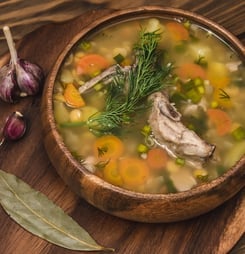
What could be simpler than making the world a better place, spreading love and generosity, with a bowl of soup?!
That’s right, kindness comes in many forms and in this case, the theme is all about giving a “Hug in a Bowl”. And there’s something wholly satisfying about enjoying a warm, hearty cup or bowl of soup that has been lovingly prepared and shared by someone who cares on Soup It Forward Day.
Soup It Forward Day Timeline
Early public soup kitchens in Europe
Cities such as London and Paris begin operating organized soup kitchens to provide cheap or free broth to the urban poor, tying soup to charitable relief.
First recorded American soup kitchen in New York City
Amid economic hardship, a soup kitchen opens in New York City, marking one of the earliest organized efforts in the United States to serve free soup to the hungry.
Formation of London’s first independent soup kitchen charity
The first independent soup kitchen charity in London is established, formalizing year‑round provision of hot soup to those in need rather than only during crises.
Great Depression spurs widespread soup kitchens
Following the 1929 stock market crash, churches, charities and municipalities across North America expand soup kitchens to feed millions of unemployed people.
St. Vincent de Paul “soup run” begins in Dublin
Volunteers from the Society of St. Vincent de Paul launch a “soup run” in Dublin, bringing hot soup directly to people sleeping rough, a model later copied in other cities.
First modern food bank founded in Phoenix, Arizona
John van Hengel starts St. Mary’s Food Bank in Phoenix, creating a system to collect surplus food and redistribute it, which soon includes canned and prepared soups.
“Pay it forward” popularized in book and film
Catherine Ryan Hyde’s 1999 novel “Pay It Forward,” followed by the 2000 film adaptation, brings the idea of passing on acts of kindness to mainstream culture worldwide.
History of Soup It Forward Day
The idea behind Soup It Forward Day came through the creative work of Soup Sisters, a non-profit organization in Canada that has been working hard since 2009 to address the hunger crisis.
With the knowledge that soup is one of the most nourishing, well-balanced meals that can also be offered in large quantities and is affordably priced, this group started Soup It Forward Day in 2018 with the purpose of encouraging more people to provide soup donations to charities on the front lines.
The term ‘soup it forward’ is a play on the phrase ‘pay it forward’ that was first made popular in the 20th century but became part of pop culture more recently through the movie of the same name that was released in 2000.
With the idea of making the world a better place and caring for people first (rather than “paying it back”), in this case, the concept has been applied to sharing a meal of soup with someone who needs it.
With the hope of continuing to tackle the rampant food insecurity that is sweeping through communities, Soup It Forward Day encourages individuals, families and groups to get involved in three simple ways: making soup, sharing soup and giving soup.
How to Celebrate Soup It Forward Day
Several types of opportunities exist for getting involved with Soup It Forward Day, getting started with some of these ideas:
Host a Soup-Making Event
Groups, businesses and others who want to participate in Soup It Forward Day might choose a soup-making event that fosters friendship and community while making a difference for someone who needs a hot meal.
Gather donations for supplies and consider partnering with a cooking school or others with industrial kitchens to make and then deliver “Hugs in a Bowl”.
Those in Canada can find more information about locations that sponsor these events through the Soup Sisters website.
Support a Soup Kitchen or Food Bank
Even those who aren’t interested in a cooking event can be involved with Soup It Forward Day by supporting a local soup kitchen, food bank, homeless shelter or other place that serves food to those in need.
Contact the organization to find out what kind of donations they need – often canned soup is welcomed – and then organize a food drive to boost the supplies that are needed.
While this day takes place in the early spring, many food banks find themselves short on supplies in mid-winter, so that might be another good time to act!
Facts About Soup It Forward Day
Soup May Be One of Humanity’s Oldest Prepared Foods
Archaeological evidence suggests that people were boiling ingredients to make soup-like foods at least 20,000 years ago.
Pottery fragments from Xianrendong Cave in Jiangxi Province, China, dated to around 20,000–19,000 years before present, show scorch marks and residues consistent with boiling, which researchers interpret as some of the earliest known containers used to cook grain and meat mixtures in water.
Soup Kitchens Grew Out of 19th‑Century “Soup Societies”
Organized charitable soup distribution in Europe expanded rapidly in the late 18th and 19th centuries, when “soup societies” in places like Paris and London began supplying cheap or free soup to the urban poor.
These efforts, often backed by philanthropists and churches, laid the groundwork for the modern soup kitchen model that became widespread during economic crises such as the Great Depression.
A Simple Bowl of Soup Can Help Tackle Food Insecurity Efficiently
Because soup can be made in large batches from low-cost ingredients, it fits well into emergency food programs.
Research on institutional and community feeding programs notes that soups and stews are one of the most efficient ways to stretch protein, vegetables, and grains across many portions while still meeting basic nutrient needs, which is why they are common offerings in shelters and humanitarian settings.
Chicken Soup’s “Healing” Reputation Has Some Scientific Support
The idea that chicken soup helps people recover from colds is not only cultural. A study from the University of Nebraska Medical Center found that traditional chicken soup inhibited the movement of neutrophils, a type of white blood cell involved in the inflammatory response, in laboratory tests.
This suggests chicken soup may have a mild anti‑inflammatory effect that could ease upper respiratory symptoms, even if it is not a cure.
Soup Plays a Central Role in Many Cultural Comfort Foods
Across cultures, soup is often the dish people reach for in times of illness, grief, or celebration.
Japanese miso soup, Jewish chicken soup, Vietnamese pho, Mexican caldo de pollo, and West African pepper soups each carry strong emotional and symbolic meanings within their communities, functioning as comfort food and often served at key life events or during seasonal transitions.
Modern Soup Kitchens Remain a Frontline Response to Urban Poverty
In many North American and European cities, soup kitchens act as entry points to broader social services.
Studies of homeless service systems describe how a “simple meal” is used to build trust, after which staff and volunteers connect guests to housing assistance, health care, addiction treatment, or job programs, showing how soup distribution has evolved into a gateway for more comprehensive support.
Liquid Meals Like Soup Can Improve Satiety Despite Their Volume
Contrary to the assumption that liquids are less filling, controlled trials have shown that people often report greater fullness and eat fewer calories at subsequent meals after consuming a vegetable soup “starter” compared with having water plus solid foods.
Researchers believe the combination of fiber, protein, and warm liquid slows gastric emptying and helps regulate appetite, which is why soup is widely used in weight‑management and clinical nutrition settings.